Rose leaves strong legacy of growth and service at BNSF Railway NEWSWIRE

Rose leaves strong legacy of growth and service at BNSF Railway NEWSWIRE

By Bill Stephens | October 5, 2018

| Last updated on November 3, 2020


Get a weekly roundup of the industry news you need.

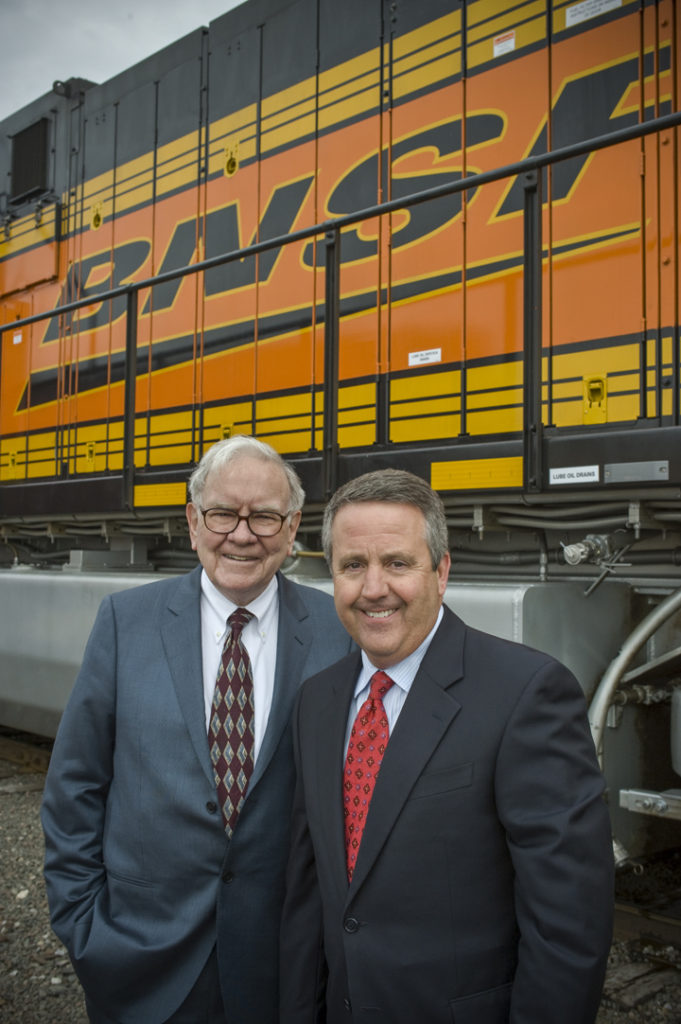
MattRoseWarrenBuffett
BNSF Railway Executive Chairman Matt Rose, right, and Berkshire Hathaway founder Warren Buffett pose in front of  BNSF locomotive in this undated photo.
BNSF Railway
FORT WORTH, Texas — BNSF Railway Executive Chairman Matthew K. Rose, who will retire in April, is being praised for a nearly two-decade leadership tenure defined by strong growth, service, and the sale of the company to Berkshire Hathaway.

“I think he and his management team took BNSF to a higher level,” says Rob Krebs, who put BNSF together and was Rose’s predecessor as chief executive. “I don’t know how it can get much better. The combination of service that they have been able to provide, together with reduction in costs that continued after I retired, made the company the leader in the United States and maybe the best freight operation in the world.”

Like a hotshot Z-train, BNSF under Rose’s leadership overtook rival Union Pacific to become the largest railroad when measured by volume and revenue. BNSF’s traffic grew at more than twice the rate of the closest U.S. railroad, Norfolk Southern. And it was second only to Canadian National in overall growth, largely due to CN’s development of the Port of Prince Rupert, B.C., into an intermodal juggernaut.

Surpassing UP – which boasts a larger network that reaches virtually every major market in the West via its own rails – was no small feat.

“It proves that BNSF is the premier rail carrier in the country,” Krebs says. “Growth is the proof in the pudding. It means two things. First, you made the necessary investments to accommodate it. And secondly, you have customers who want to use the system.”

Rose has said that beating UP was never a consideration. Instead, BNSF focuses on bringing more traffic to its railroad — whether it comes from the highway or is market share gained at UP’s expense.

Independent analyst Anthony B. Hatch says Rose has been a “seminal leader” for BNSF and for the industry thanks to his efforts to influence transportation policy in Washington.

“Under his leadership, BNSF became perhaps the leader of the railroad renaissance,” Hatch says. “He picked up on Krebs’ intermodal development and ran with it — making BNSF the pre-eminent intermodal leader in the world, really.”

Hatch credits Rose for the way BNSF redesigned service to agricultural shippers, which helped to end — or at least reduce — the century-old hostility between grain shippers and railroads.

BNSF’s philosophy is that customer service drives profitability, the virtuous cycle of reinvestment, and provides the railway with a social license to operate.

This goes against the grain of the current trend at the publicly traded Class I railroads, which is to reward investors as quickly as possible through a combination of share buybacks, cost-cutting, rate increases, and a focus on the operating ratio.

“Everybody’s desperate for profits. You can’t have sustainable profits if you don’t have good service first,” Krebs says. “And that means it takes investment and a culture that only accepts superior service and putting our customers first. And that’s what BNSF has continued to do — and it’s paid off.”

This long-term view of the business is one of the things that attracted Berkshire Hathaway Chairman Warren Buffett to take a stake in BNSF in 2006, then buy the entire railroad in 2010.

“It was a very lucky day for me and for Berkshire Hathaway when I met Matt Rose,” Buffett said in a statement. “Under Matt’s management, BNSF has become a major source of profit and pride for Berkshire. And, as a citizen, Matt has been an exemplar for corporate leadership.”

Buffett said the acquisition of BNSF, which was announced in 2009 in the depths of the Great Recession, was “an all-in wager on the economic future of the United States.”

At the time, Rose said, “We admire Warren’s leadership philosophy supporting long-term investment that will allow BNSF to focus on future needs of our railroad, our customers, and the U.S. transportation infrastructure.”

Rose since has said that BNSF continues to operate under Berkshire Hathaway ownership the same way it did as a publicly-traded company.

“I mean, at the end of the day, we still hold ourselves accountable to the same stuff we used to,” Rose said last year. “We need price. We need volume. We’ve got to be judicious with capital.”

Rose became CEO in 2000 and was named executive chairman in December 2013, when Carl Ice was promoted to chief executive. As executive chairman, Rose stepped back from day-to-day matters to focus on planning, market positioning, and public policy issues affecting BNSF and the railroad industry.

The executive chairman position was created for Rose and will not be filled upon his retirement, BNSF says.

At one time Rose was considered a possible successor to Buffett, who is 88. But earlier this year Berkshire promoted two other executives to vice chair positions, signaling they were potential replacements for Buffett and his partner, Charlie Munger, 94.

No reason was given for Rose’s retirement at age 58.

“I have been incredibly fortunate to work alongside some of the most talented people in the transportation industry,” Rose said in a statement. “Through my 26 years at BNSF — 19 in leadership — I have seen enormous change in our economy. Our company has navigated those changes well and now is extremely well positioned for the next several decades. It has been an honor to lead this organization.”

Under Rose, BNSF was a technological leader, racing out to full deployment of positive train control long before the other Class I systems. It also was an early adopter of things like drones to inspect track and bridges. And BNSF sought a labor agreement, unsuccessfully, that would have permitted the use of one-person crews on PTC-protected lines in the Pacific Northwest.

BNSF also credits Rose with developing leaders within the company, ensuring that it has a strong management pipeline. Insiders praise Rose for his people management skills. They also say he was a rare railroad CEO who excelled at all aspects of the job, from operations and marketing to finance and government relations.

Rose’s tenure was not all smooth sailing.

The harsh winter of 2013 to 2014, combined with a record grain harvest and the spike in crude oil traffic in the Dakotas, brought Chicago to a standstill and BNSF to its knees on the Northern Transcon linking the Windy City and the Pacific Northwest.

Federal regulators held hearings as shipper discontent boiled over. BNSF responded by spending $1 billion on capacity improvements, including double-track, passing sidings, and centralized traffic control.

Rose credited BNSF employees for braving brutal -30 degree temperatures to keep traffic moving. “Those were horrific conditions, but they stuck it out,” Rose said at the time.

Krebs says Rose has had a fantastic career and should be proud of his record of success at BNSF. “Matt has done a great job,” he says.

Share this article