“This makes lots of sense to reach further into the Ohio Valley without getting into the crosstown rubber-tire moves in Chicago,” says intermodal analyst Larry Gross.
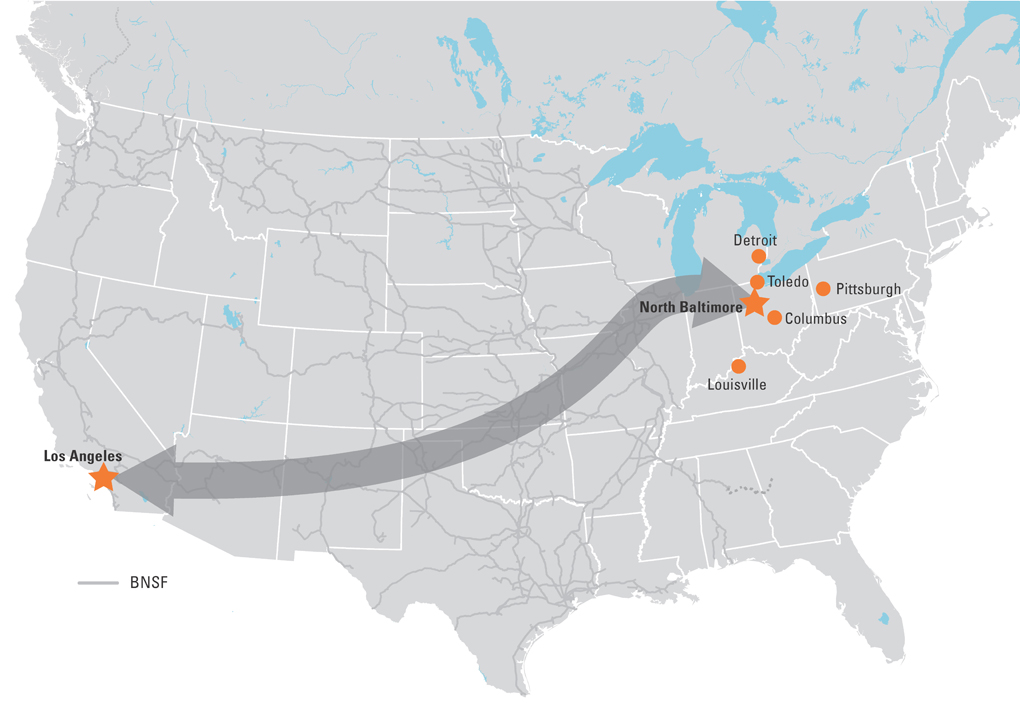
BNSF is essentially trading the cost of a rubber-tire interchange move in Chicago for extended drayage from North Baltimore to destinations that include Detroit; Cleveland, Columbus, and Cincinnati, Ohio; and Louisville, Ky., Gross says.
“I think this will eventually work,” Gross says.
Generally the goal of intermodal shippers is to use rail to get as close as possible to the freight’s ultimate destination, Gross says. But CSX has streamlined its intermodal network to reduce operational complexity, cut costs, and boost profitability.
Last year, CSX scuttled its hub-and-spoke model for serving low-density intermodal markets and scaled back service to Louisville and Detroit, among other places. The Northwest Ohio Terminal at North Baltimore was a container-sorting facility in the old hub-and-spoke model, which added cost and transit time for traffic that’s both price- and service-sensitive.
Now the underused, modern terminal is being repurposed as CSX shifts toward an intermodal strategy that centers on point-to-point service in high-volume lanes.
“We are excited to transform Northwest Ohio into a regional demand point that provides attractive solutions for customers and supply chain needs,” CSX CEO James Foote said in a statement.
The terminal is ideally situated, CSX says, with a population of 30 million within a 200-mile radius.
There’s not currently much drayage capacity in North Baltimore, which means the new service at first is likely to cater to national trucking companies like J.B. Hunt and Schneider National, which have their own drivers.
In the near term, the lack of drayage capacity will be problematic for other intermodal users.
“It’s not like drayage capacity will magically appear,” Gross says.
But he expects local drayage capacity to develop as intermodal volume ramps up at the terminal.
CSX’s long-term growth plan for Northwest Ohio includes the construction of a logistics park adjacent to the terminal. The logistics center should help develop a much larger local market, Gross says, including loaded backhaul opportunities to export agricultural products to Asia.
The logistics park is being developed by NorthPoint Development of Kansas City, Mo., which built a logistics park on BNSF Railway in Kansas City. NorthPoint officials did not return a Trains phone call seeking comment on the construction timeline or cost of the 500-acre center.
The logistics park ultimately will make North Baltimore a more attractive destination for shippers, Gross says. “It’s a longer-term play,” he says, noting that the facility likely will be similar to logistics parks on BNSF in Joliet, Ill., Oklahoma City, Kansas City, and Alliance, Texas.
Locating a logistics park adjacent to an intermodal terminal dramatically reduces drayage costs for shippers and reduces their carbon footprint, BNSF says.
CSX says the BNSF direct service will increase container volume at North Baltimore. The number of trains calling at the terminal won’t change initially, but is expected to grow over time.
When the service begins on Oct. 29, with departures in both directions five days a week, the haulage traffic will move in existing intermodal trains that BNSF and CSX interchange via steel wheel in Chicago.
The key with the haulage agreement is that it will give BNSF more control over the move east of Chicago, Gross says. It’s similar to a haulage agreement BNSF has with CSX to handle intermodal trains between Birmingham, Ala., and Atlanta.
“The offering provides another option for BNSF customers to move their shipments between Los Angeles and the Ohio Valley region,” BNSF spokeswoman Amy Casas says. “The new service will provide access to some of the fastest-growing industrial and consumer markets in and around northwest Ohio, including Toledo, Columbus, Detroit, Louisville, and Pittsburgh.”
The new CSX-BNSF service to North Baltimore is not directly related to changes CSX made to steel wheel interchange at Chicago that CSX announced in August as part of a streamlining of its intermodal network.
“However, both changes support the intermodal strategic priorities, which include a focus on high-density lanes and the optimization of efficiency within train and terminal operations,” a CSX spokeswoman says.
CSX also announced the launch of new direct international service between North Baltimore and the Ports of New York and New Jersey. Gross says North Baltimore will likely forward this international traffic via highway to destinations in Southern Michigan, western Ohio, and Indiana.