

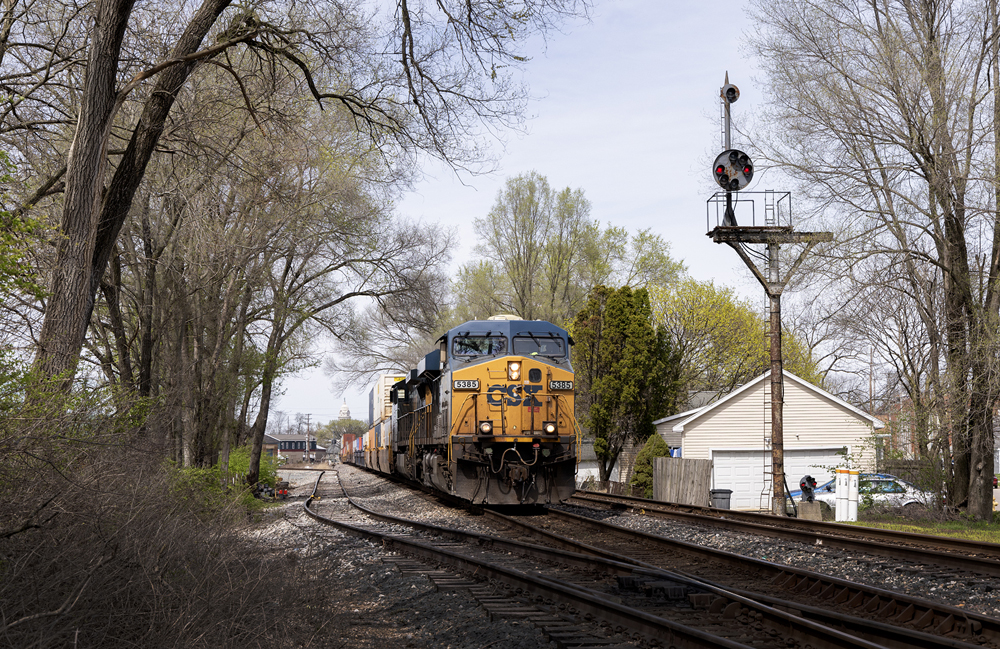
CLEVELAND, Ohio — Railroads have 720 minutes from when an engineer or conductor reports on-duty until his or her hours of service reach 12. This is a finite amount of time to perform safety checks, gather paperwork, and prepare locomotives and the train for departure. Line-of-road presents all kinds of opportunities for more delays. Assuming the train starts moving within two hours of the crew’s reporting time, the average manifest train may move 250-to-300 miles with one crew, but that’s without any work en route, minimal line-of-road delays, and maintaining a continuous 30-mph cadence for the rest of the trip. You can begin to appreciate how getting from terminal A to terminal B isn’t as straightforward.
But what if you don’t have the crew resources available at terminal A to advance the train to its next destination? Maybe the crew base is sick, or there are too many engineers rested and not enough conductors? Or maybe neither? Now hundreds of freight cars, each carrying product needed by customers, begins accruing terminal dwell while a trainmaster counts down the hours until a rested crew member is eligible for call. Once he or she reports to work and moves the freight, the issue is resolved, albeit behind schedule, right?
But what if there’s a high priority stack train out on the line-of-road that has to keep moving and is short on time because of something else? There goes your one crew. The perfect storm happens on railroads more often than you may think. It’s a recurring problem at terminals that move a lot of freight with few railroaders. It’s one reason local trainmasters have tough jobs. Each day is like putting together a puzzle with the pieces of three or four other puzzles.
Inefficient and cost prohibitive for railroads
Crews have good reasons for disliking them, but deadheads, or extended windshield time deadheading crews from their originating terminals to away terminals to hop on trains, or take rest for tomorrow’s freight, is sometimes a necessary evil. Small short lines to major Class Is manage deadheading, which adds up in costs from taxis, to hotels, and the overall labor expense of paying two crew members to deadhead in a vehicle. In the time it takes a crew to drive to an away terminal, they could have moved freight 100 miles had they reported to their home terminal.
Windshield time is a necessary part of the business though. In using the same scenario above, let’s suggest 150 freight cars have been sitting at terminal A for 10 hours waiting for a conductor to be rested. A couple hours later, a more pressing issue surfaces, and that only conductor in your roster is headed somewhere else to remedy a more time-sensitive problem. The clock restarts and you’re waiting another 12 plus hours for a rested crew member. Those 150 cars are going to stay at this terminal for at least 22 hours because of these circumstances.
Or, you can deadhead a rested crew from terminal B, who is sitting at the house and ready to go to work, and drive them to terminal A to turn and advance the train to terminal B, which is their home terminal upon arrival. There’s no hotel stay involved for these railroaders, and except for a 2 to 3 hour taxi ride, these railroaders are homebound.
Sure, you are not getting the full shift to maximize hours, but that freight will start moving within 3 to 4 hours, as opposed to another 12 to 14 hours. At the end of that crew’s shift, those 150 cars may have moved 125 miles closer to its next destination, meanwhile had the trainmaster waited for the conductor at terminal A, that train would still be at the original terminal.
These types of scenarios likely play out far too many times a day and there’s not a lot that railroads can do to fix it. It boils down to having the right amount of crews at the right places. However, as we discovered during the COVID-19 pandemic, labor was, and to some extent, still is competitive. You also don’t want to hire too many railroaders for too few trains or vice versa.
Keepin’ it moving
This is why I’m empathetic to these local managers and the railroaders who make tireless sacrifices to keep customers’ carloads moving. By keeping that freight moving, perhaps you’ve kept a customer’s entire production shift from having to work a weekend shift to make up for what otherwise would’ve been an unsustainable delay.
The methodology for this opinion piece originates from a letter written by U.S. Sen. Sherrod Brown, a democrat from Ohio, who called on CSX to reconsider its plans to adjust the size of its Collinwood Yard crew base in Cleveland. The Senator is concerned, in a written letter to CSX President and CEO Joseph Hinrichs, that the railroad’s decision to reduce its crew base in Cleveland will disrupt railroaders’ lives, decrease reliability, increase train delays, delay customer’s freight, and cause Ohioans to be stuck at grade crossings longer.
I understand the Senator’s concerns and those raised by his constituents, and I appreciate his interest in the railroad, but what if there is more to the story? And what if CSX’s decision to re-allocate crews to places other than Cleveland actually remedies another issue or series of issues we are not privy to, perhaps for a reason similar to what I hypothetically suggested above?
Maybe re-drawing the crew base map gives the railroad more flexibility to keep crews and freight moving efficiently? There’s a lot that happens behind the curtain that is complicated to explain to the average Joe? The pun was intended here.
CSX has proven to be a more customer-focused, community-oriented, and employee-centric railroad under the leadership of Mr. Hinrichs, a native Ohioan, might I add. This isn’t just my opinion, but it’s the sentiment across the organization and the customers who pay for the railroad’s services. Maybe these changes will help velocity and improve the reliability of customer’s freight?
I don’t think any railroad can afford to make a decision that achieves the opposite. There’s too much riding on railroads to be successful and accountable. I think there’s more to this one siloed example in Cleveland and I hope this column explains that.
— Carload Considerations is a monthly Trains News Wire commentary series. It discusses the freight rail industry, commodities, and economic trends. Its views are the opinion of its author with no particular emphasis on a specific railroad or shipper.
Share this article