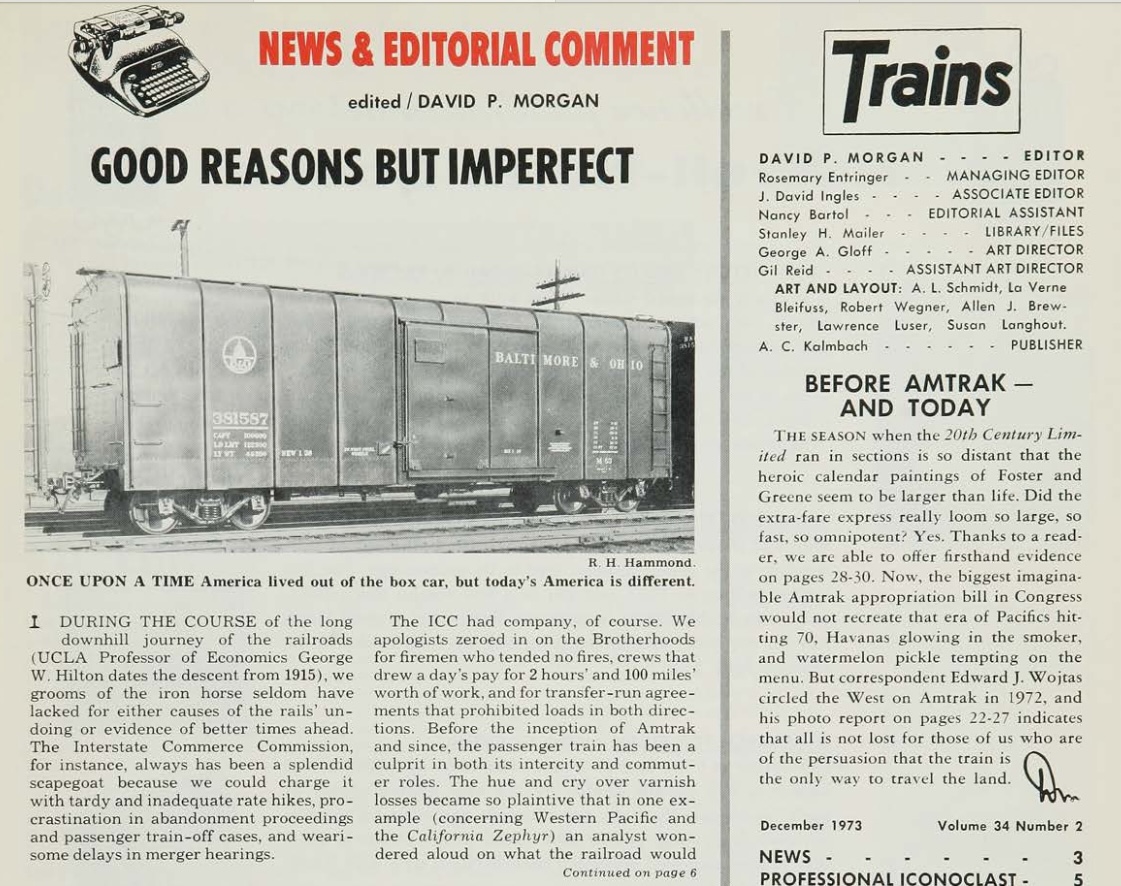
While searching the Trains archives the other day, I stumbled upon a December 1973 commentary by Editor David P. Morgan, who was pondering the future of railroading. I was struck by how many of the same concerns that he raised during one of the darkest periods in rail history still ring true today as the Class I railroads struggle to grow.
“During the course of the long downhill journey of the railroads … we grooms of the iron horse seldom have lacked for either causes of the rail’s undoing or evidence of better times ahead,” Morgan wrote.
Morgan’s undoing category included onerous Interstate Commerce Commission regulations that tilted the playing field in favor of trucks and barges and airlines while saddling railroads with unprofitable routes and services. He placed blame on rail union featherbedding. And DPM lamented that a new Amtrak system didn’t pay host railroads enough to cover the costs of operating its passenger trains.
“Yet,” Morgan wrote, “we tell ourselves and anyone else who will listen that our day is coming.” There were plenty of arguments in favor of better times ahead. Technology and mergers would be saviors. Projections of economic growth would translate into an unthinkable leap in ton-miles. Thanks to the dawn of the environmental movement and the energy shortage, railroads would become the ideal way to move freight and people over land with lower fuel use and less air pollution.
“Now, all we’ve told ourselves and anyone else who will listen is plausible, defensible, demonstrable, even if our track record to date says that our arguments have not been convincing,” Morgan wrote. “The trouble is, our reasons – including the ecology/energy-shortage plea – have been good but imperfect. The record indicates that there is less and less demand for much of today’s railroading. Sometimes the rails’ prices … are too high. Mostly, though, the rails’ service in terms of reliability, speed, and freedom from damage is inferior to that of the truck.”
The America that depended on boxcars, Morgan concluded, had been replaced by one reliant on freeways and overnight delivery of truck-sized shipments and “otherwise behaves in a manner increasingly incompatible with freight trains that average 20 mph and freight cars that spend more than 21 of each 24 hours being loaded, unloaded, humped, or switched, or standing still.”
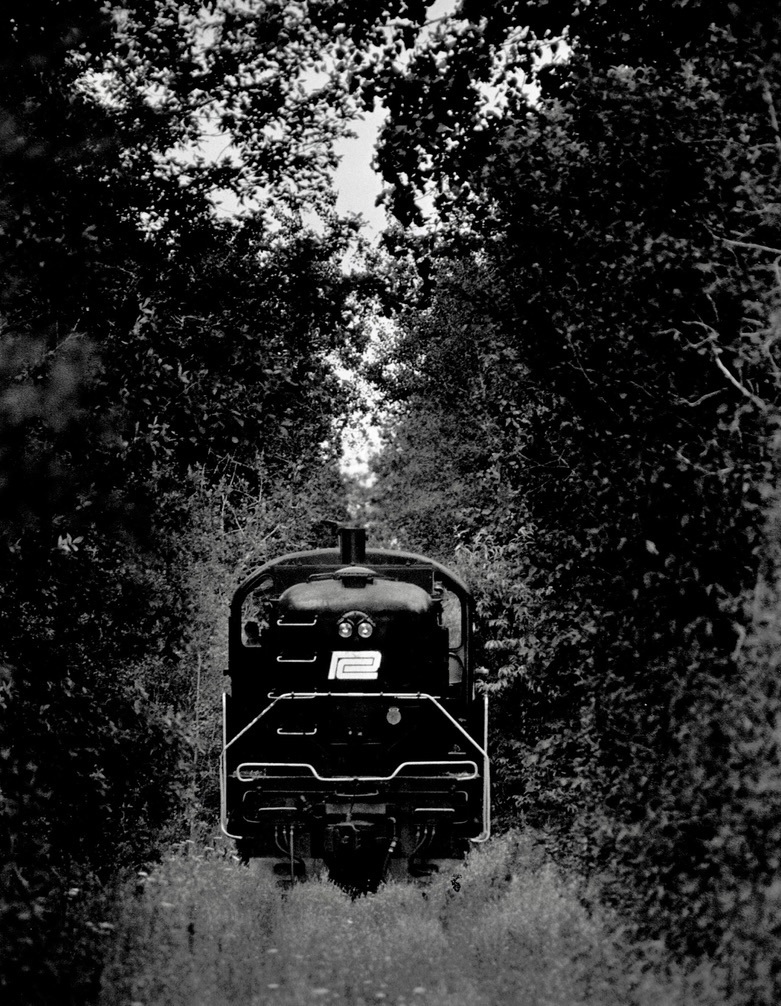
What has changed in the 51 years since Morgan wrote those words? Well, everything. And nothing.
In the Everything Department: The Staggers Act of 1980 brought partial deregulation. Conrail rescued the bankrupt Northeastern railroads. Merger after merger resulted in just six major systems. Unprofitable and redundant routes were ripped up or spun off, while duplicate yards and shops were scrapped. Commuter operations and their red ink were shifted to state and local agencies. Freight trains run with a crew of two. And technology? DPM would hardly recognize it.
All this has made railroads immensely profitable. There are no more Penn Centrals, standing derailments, or mainline trackage that barely meets branchline standards. Today’s physical plant is immaculate. 
But in the Results Department – that is, taking freight off the highways and fulfilling the optimism of 1973 – the record has been underwhelming.
Where railroads have been handed business that’s high volume and long haul, they’ve done well. Think Western Canada bulk and energy-related business, Powder River Basin coal, Gulf Coast chemicals, and international intermodal. Railroads also built a domestic intermodal network that, while skeletal, is a successor to the boxcar.
And yet trends in overall rail traffic fit squarely in the Nothing Has Changed category despite the slaying of the ICC bogeyman. Carload volume badly lags economic growth, industrial production, and the rise in truck tonnage. Intermodal has been losing share to trucks since 2015. And thermal coal is a dead man walking.

Sadly, Morgan’s operational stats are not out of date, and rail service is still no match for trucks.

This much is certain: The more things change, the more they remain the same.
You can reach Bill Stephens at bybillstephens@gmail.com and follow him on LinkedIn and X @bybillstephens
Share this article