

The California Air Resources Board pitted a standard diesel-electric locomotive consist against zero-emissions alternatives – including battery-electric models from Wabtec and ProgressRail as well as Canadian Pacific Kansas City’s hydrogen fuel cell locomotive – in a hypothetical test run from the Port of Los Angeles to Barstow, Calif.
The analysis concludes that the current zero-emissions locomotives could handle a 130-car double-stack train on the 174-mile run, which includes the 2.2% climb up Cajon Pass.
CARB, as the air resources board is known, on Jan. 1 imposed an in-use locomotive rule that requires switching, industrial, and passenger locomotives to be zero-emissions by 2030 and freight line-haul locomotives to be emissions-free by 2035.
The controversial rule, which is tougher than federal regulations, must be approved by the U.S. Environmental Protection Agency. Railroads have challenged the rule in federal court and have lobbied against it, including during a House Investigations & Oversight subcommittee hearing on Thursday.
CARB’s locomotive analysis – released last month and conducted all on paper, rather than on rails – evaluated the performance of a typical diesel consist with 4,400-horsepower locomotives, Wabtec’s FLXdrive heavy-haul battery electric, ProgressRail’s SD70J-BB battery electric, and CPKC’s hydrogen fuel cell locomotive accompanied by a tender that would carry extra hydrogen fuel.
The report calculated the power requirements to handle the stack train between Los Angeles and Barstow, including the 3,760-foot elevation gain from the port to Cajon Summit. The analysis assumed that each of the 130 stack cars carry containers weighing 19 tons each. BNSF Railway and Union Pacific operate over the pass today.
The hypothetical train would require one of the following consists:
- Seven 4,400-horsepower diesel electrics
- Six FLXdrive battery electrics
- Four SD70J-BB battery electrics
- Six CPKC hydrogen fuel cell units
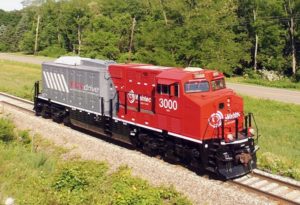
In what appears to be an afterthought, the analysis says the use of overhead catenary power between Anaheim and the top of Cajon Pass would reduce the number of locomotives required. “An operator would only need two [overhead catenary] compatible locomotives and two battery-electric locomotives to complete the trip,” CARB concludes. “This is assuming that the [catenary] compatible locomotives can produce at least 6.4 megawatts of traction power, such as the Siemens Vectron, a European freight locomotive.”
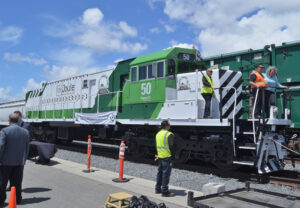
“While the Regulation does not require the purchase of new zero-emission locomotives, it is worth noting that such locomotives are available for purchase today, and could be used now in trains running between the ports of Long Beach and Los Angeles and San Bernardino or Barstow,” Abbs said. “These zero-emission locomotives have sufficient power, range, and traction to entirely replace the diesel locomotives even along that very steep route — a route that runs through some of the most heavily polluted areas in California.”
He also noted that overhead catenary, which is widely used around the world for freight operations, is more than 100 years old and is a proven technology.

There are no proven zero-emissions locomotives that are commercially available for use in North American main line freight operations, Dick says. Even the use of overhead catenary would require the development of a high-traction, high-horsepower locomotive that could handle heavy North American freight trains, he says.
“Each zero-emission technology has unique technical, safety, and implementation challenges that must be addressed before widespread deployment is possible,” he told the House panel, noting that the CARB regulation does not allow railroads enough time to develop and transition to viable zero-emissions locomotives.
“There are numerous historical examples of railway technologies that appeared to be good ideas on paper or in the lab, but failed when rushed to market without proper testing to expose them to the long-term realities of North American heavy haul freight mainline operations,” Dick told the panel.

“While the spirit behind CARB’s regulation is consistent with the rail industry’s environmental commitment, the regulation itself is unworkable and infeasible,” Jefferies told the panel.
The CARB rule, which also would phase out the use of older locomotives, would ultimately prevent 75% of the North American locomotive fleet from operating in the state, Jefferies said. Even if railroads were able to develop zero-emissions locomotives for use in California, that would require engine changes just outside the state and create interoperability headaches for freight railroads.
Baker said it would be impossible for California short lines to afford compliance with the CARB rule – and that it likely would put some short lines out of business, which in turn would shift rail freight to the highway.
“These effects will be felt in the form of higher costs for shippers and consumers and will be witnessed in the form of more trucks on our roads, greater congestion on our highways, more particulate matter in our environment — and, ironically, more greenhouse gas emissions in California and elsewhere,” Baker told the panel.