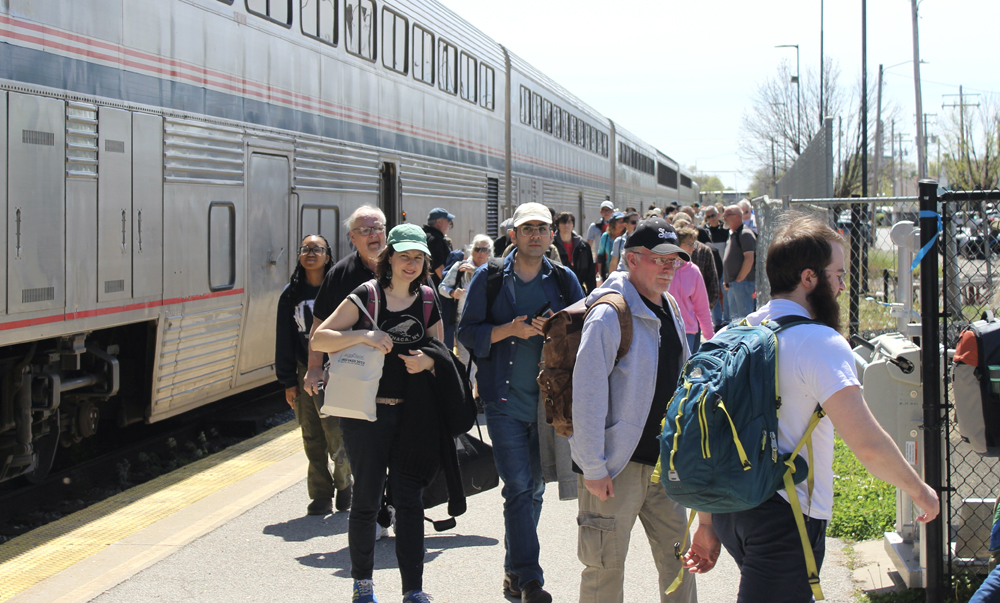
CHICAGO — More than 430 passengers rode at least a portion of Amtrak’s southbound Saluki and northbound Illini between the Chicago and Carbondale, Ill., on Monday. Many were taking advantage of a schedule change which made it possible for customers to witness a rare four minutes of totality in the southern Illinois city during the April 8 solar eclipse [see “Amtrak modifies April 8 schedules …,” Trains News Wire, March 22, 2024].
Far from everyone aboard the sold-out trains was on a one-day excursion. That’s because these trains comprise one of three round trips (including the City of New Orleans) providing daily mobility through central Illinois. Amtrak spokesman Marc Magliari tells News Wire that Monday’s morning southbound Saluki No. 391 reached its maximum passenger count of 313 passengers leaving Champaign, Ill., while the late afternoon northbound Illini hit its peak load of 325 pulling out of Effingham, Ill. The difference between those numbers and the “total carried” figures of 432 and 437, respectively, reveals that more than 100 seats on each train changed occupants during the trips.
This is typical of most Amtrak intercity trains, both regional and long distance. The more capacity a train can offer, the greater the opportunity to accept extra travelers whose trips may not synch with when others vacate seats or sleeping-car space.
Each of the April 8 departures was intermittently sold out for weeks in advance, even before Amtrak made its schedule adjustment. Some passengers interviewed on each train could only book one way because it was either sold out in the other direction, or the southbound run’s schedule had not been revised when they made travel plans. More people could have been accommodated if Amtrak had been able to provide additional coaches [see “Superliner shortage limits Illinois eclipse viewing …,” News Wire, April 5, 2024].
Host railroad Canadian National requires seven Superliners to be assigned on the route [see “Seeking answers on loss of shunt …,” News Wire Sept. 6, 2023. Of those, four coaches are generally sufficient to handle regular patronage. The other three are “axle-count” Superliner. They are often cars that are not suitable for revenue service for a variety of reasons (for example, inoperable air conditioning), and, since they are not occupied, can be of any available car type.
Monday’s Saluki/Illini Superliner consist looked like this:
— Two accessible coaches with lower-level seating.
— One coach-baggage: the lower level compartment accommodates roll-on-bicycles; there is no checked baggage.
— One coach-café: half of upper level is business class; café is on lower level
— One coach-café: normally carried unoccupied as “axle count” car
— One Sightseer Lounge: unoccupied axle count car
— One transition sleeping car: unoccupied axle count car
Management did open up the axle-count coach-café for sale the previous week and seats were quickly sold. Additional onboard service staff and supervision was on hand in the active coach-café to handle the expected crowds, and serving began shortly after departure. With so many passengers on the train, lines quickly formed in the downstairs hall back to the bathrooms and stairwell when the morning train left Chicago, but the efficient attendants kept service moving and made announcements encouraging travelers to “come on down” when there was a lull.
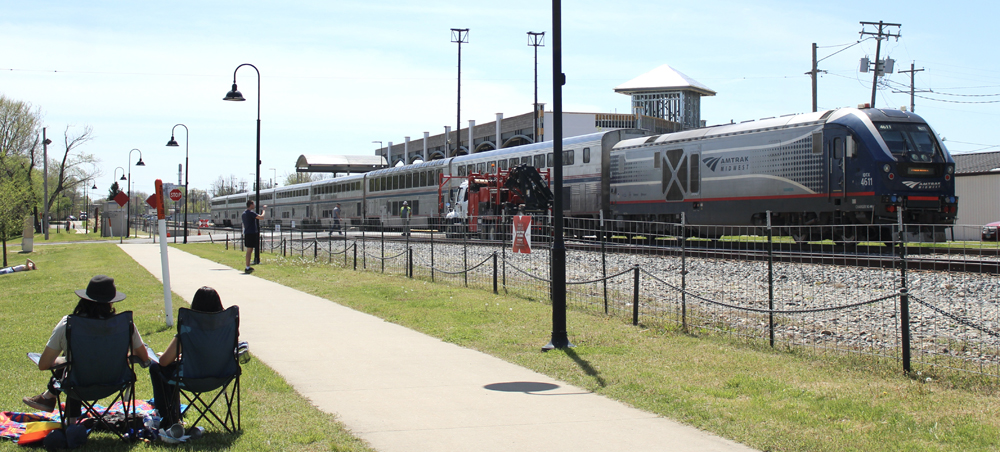
Any Superliner equipment can be tapped for axle count duty and those cars are always closed to revenue passengers, as they were on the southbound Saluki. Conductors set up shop in the Sightseer lounge, but discussion by employees overheard in the working café noted that the car hadn’t been cleaned. The ordeal of shifting food and beverage stock for the northbound trip was out of the question, but someone suggested that the Sightseer lounge could be cleaned along with the coaches during the Carbondale layover. Its designated axle-count status would also have to be reversed.
Sure enough, the Sightseer lounge interior — if not the grime-caked exterior — was spotless as passengers boarded the afternoon northbound run. Although the “employees only” sign had been switched from the lounge communicating door to the transition sleeper’s inside door, conductors never announced the car’s availability.
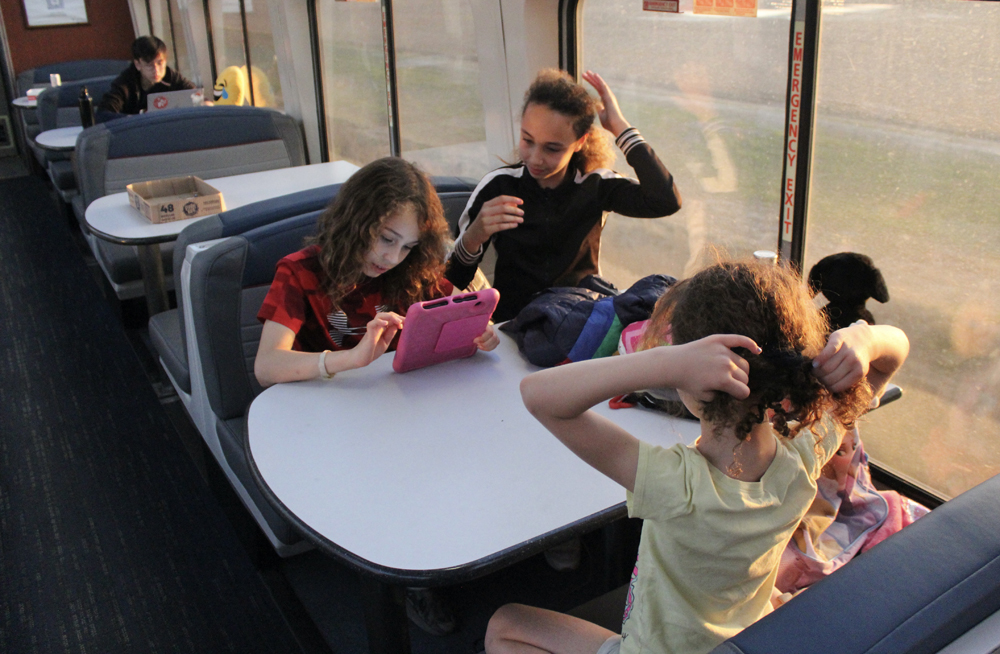
What they did do, however, was direct passengers traveling in groups of two or more boarding at stops after Carbondale to “keep walking” to the front of the train, knowing that finding two seats together would otherwise be difficult. The result: the Sightseer filled up with travelers who would otherwise have been separated.
On long-distance trains, Amtrak coach attendants and conductors generally work off manifest information to block coach seats so that everyone can sit together. That would have been a challenge, but not impossible, here, with hundreds of passengers boarding at the train’s origination point and no assigned coach attendants.
The big takeaway, though, is that the Sightseer lounge is a valuable asset that can add “only on a train” enjoyment to the travel experience, not just in the safety valve role it played on April 8. Anyone could see that on the faces and behavior of happy travelers. Every table and nearly every seat was filled following stops at Du Quoin, Centralia, and Effingham. Conductors stayed in the lower level and food service wasn’t offered; so what? It was the lounge space that mattered. The coach-café four cars back continued to do brisk business.
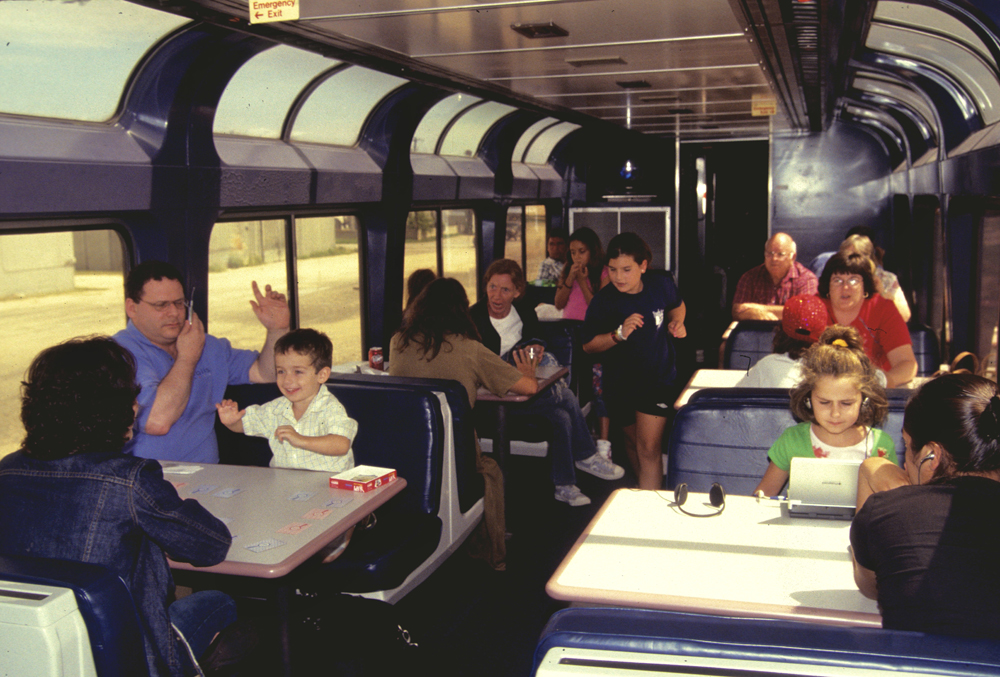
Two long-distance trains with Sightseer lounges prior to 2021, the Texas Eagle and Capitol Limited, no longer have them. The Superliner fleet has, of course, been thinned by wreck damage resulting from subsequent Empire Builder and Southwest Chief derailments, and Amtrak has cited manpower shortages in its maintenance ranks for car-shortage issues. But that Sightseer Lounge No. 33008 has been commoditized as an axle-count car — along with the fact seven lounges are not available for daily operation on the Eagle and Capitol — indicates Amtrak leadership fails to appreciate the value of the cars and has not prioritized returning them to service.
On the Eagle, one part the Sightseer Lounge played, as orchestrated by the volunteer Texas Eagle Marketing and Performance Organization and now-retired Amtrak employee Griff Hubbard, was transporting elementary school groups between intermediate stops. That promotional value has since been squandered, while others aboard have lost the convivial environment enjoyed by Chicago-St. Louis and Texas corridor passengers.
Monday’s Saluki/Illini round trip reveals no management mechanism in place to recognize the contribution a Sightseer Lounge can make to passenger enjoyment on trains sold out well in advance. Fortunately, employees delivering the service stepped in to make that happen.
— Updated at 5:35 p.m. CT to correct caption information on second photo.
Share this article