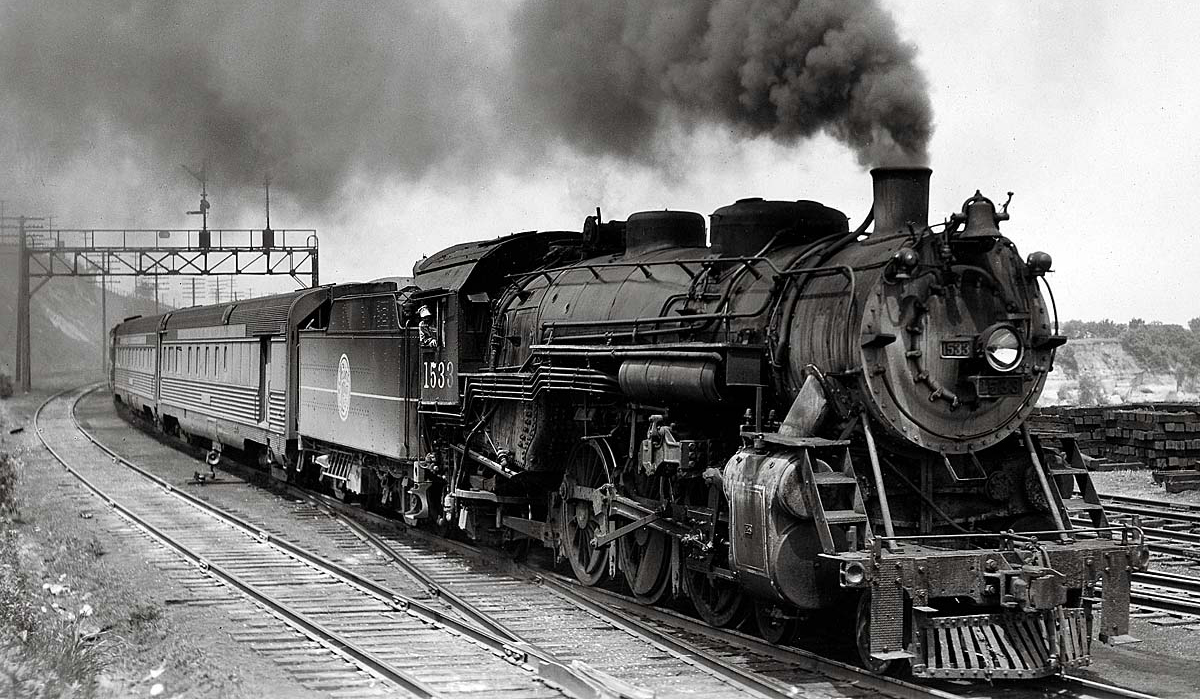
Almost every railroad has its “other” passenger train. You know, the lesser known one usually received far less press. The one that deviated here and there from the timetable of the premier train that plied the route.
Thumb through a company history and you soon realize Southern Pacific had lots of them. Almost everyone heard of the Coast Daylight that ran between Los Angeles and San Francisco, but few locals recall its evening counterpart, the Lark. Same railroad, similar equipment, usually without the diner in its later years.
Well, even more obscure was The Owl Limited on the railroad’s San Joaquin Valley line in California. The star, if you will, was the San Joaquin Daylight, an inland version of the one on the coast decked out in the same gorgeous black, red, and orange paint scheme.
The superb Owl – it was officially The Owl Limited, but no one referred to it that way – was more of a meandering counterpart that took detours along the way, some of which do not even exist anymore.
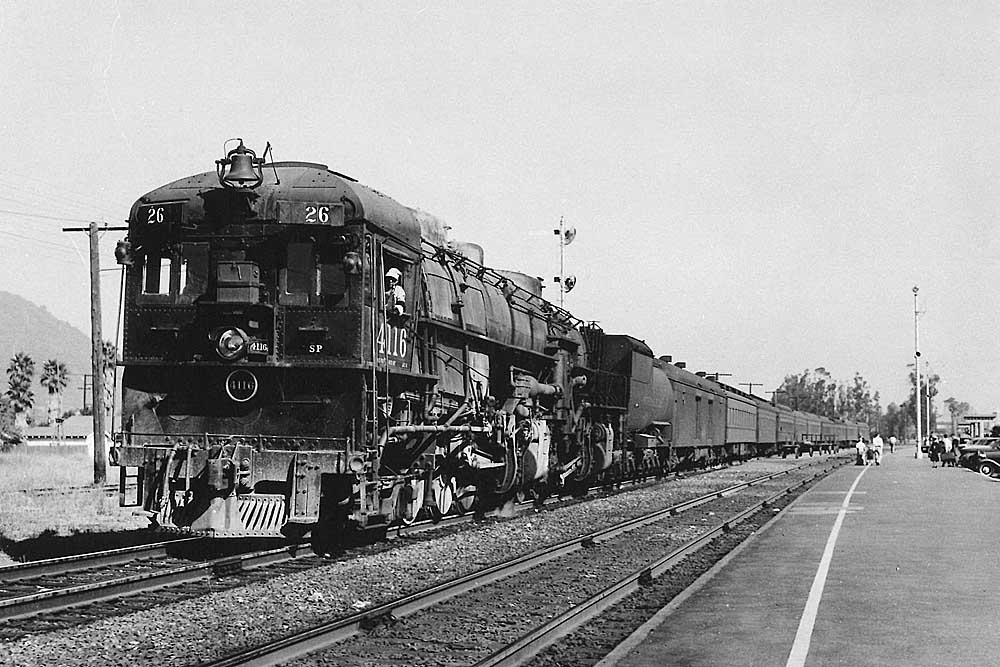
Powered by anything from 4-8-2s, 4-8-4s, and 4-8-8-2 cab-forwards in steam days, a brace of dual-service EMD F7s were usually assigned in diesel days.
Departing in the evening — southbound from San Francisco as No. 25 and north from Los Angeles as No. 26 — The Owl daily roared through the Valley and snaked its way in the Tehachapi’s beginning in December 1898. It ultimately died April 1965 with only a dozen or so passengers. In its heyday, however, it had Pullmans, coaches, chair cars, and even a decent diner.
What made it unusual was its route.
Passenger boarded a bus in San Francisco and took a company owned ferry to SP’s 16th Street station in Oakland. Subsequent stops included Berkeley, Martinez, Richmond, Crockett, Port Costa, Pittsburg, Brentwood, and Tracy, then down to Patterson, Newman, Gustine, and Los Banos before turning southeast to Dos Palos, Firebaugh, Mendota, and Kerman before coming back to the mainline at Fresno.
From there it was straight running through Selma, Tulare, Delano, and Bakersfield before climbing into the mountains. That included brief stops at Caliente, Mojave, Lancaster, and Palmdale, before crossing Soledad Canyon and hitting Saugus, San Fernando, Burbank, and ultimately Los Angeles.
As a footnote, in the early days of service, before Los Angeles Union Passenger Terminal was built in the 1940s, the official end of the line was Central Station, and before that the long-forgotten Arcade Depot. The northbound trip would be the reverse.
For the average rider, it was just the Owl, but to its followers it was, for better or worse, the superb Owl. Limited, of course.
Share this article