Common name: Grape hyacinth
Latin name: Muscari sp.
Plant type: Perennial
Plant size: 5-8″ high and spreading
USDA Hardiness Zones: 3-9
Cultural needs: Moist, well-drained, slightly acidic soil, full sun to part shade
Late summer/early autumn is the time to pick up some bulbs to plant for spring blooming. Originating from the Mediterranean region, grape hyacinths bear clusters of grape-like tubular flowers, mostly in blues, but also white, pink, and yellow. Plants stay at a manageable height for large-scale railways but spread too readily to be planted near buildings or track. Bulbs provide good color near pathways, where they can spread a bit. Blue “rivers” planted under deciduous trees en masse can be spectacular. Miniature daffodils bloom at the same time and make nice companions.
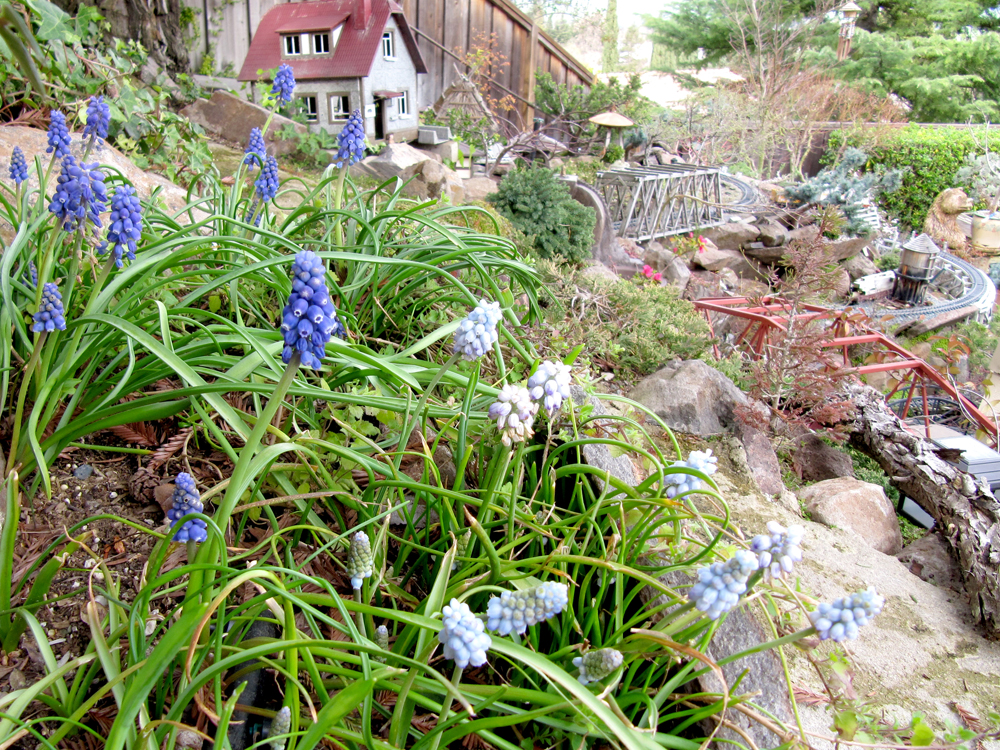
Depending on the variety and your region, blooms appear March to May and last several weeks. On hills, the 6-8″ grass-like leaves can hang over rocks as they mature. After spring blooming, allow fading, yellowing leaves to send nutrients down to the bulbs before pulling them off at ground level for compost. Bulbs should be planted 3-5″ deep (5″ deep in colder zones), 3-4″ apart, and fertilized underneath with rock phosphate or bone meal for strong roots. Azure grape hyacinth (M. azureum) may be the earliest species, and one of the smallest. M. neglectum is pictured above left, and M. armeniacum ‘Valerie Finnis’ is the lighter-colored flower. See this site for photos of 20 named varieties: www.vanengelen.com
Share this article