

This is a picture worth a thousand words. For decades, artists and photographers awed us with images of mighty locomotives scorching the high iron with hundreds of passengers or thousands of tons of freight in tow. The sun shines brightly as the wind blows the hair of the fearless engineer, perched on the armrest. The friendly conductor waves from the caboose to folks along the right of way. Those moments exist, but to pretend that every day on the railroad is a scene right out of a travel brochure is a stretch.
I’ve photographed images used to lure travelers aboard coaches and sleeping cars for a glimpse of a world that can’t be seen from a plane at 30,000 feet traveling 600 mph. I’ve also captured images of mile-long freight trains moving America’s industrial output. Another frequent subject of my Nikon, however, has been the pained exhausted face of railroaders, the grease-covered overalls, the worn gloves, the sweat-stained shirts.
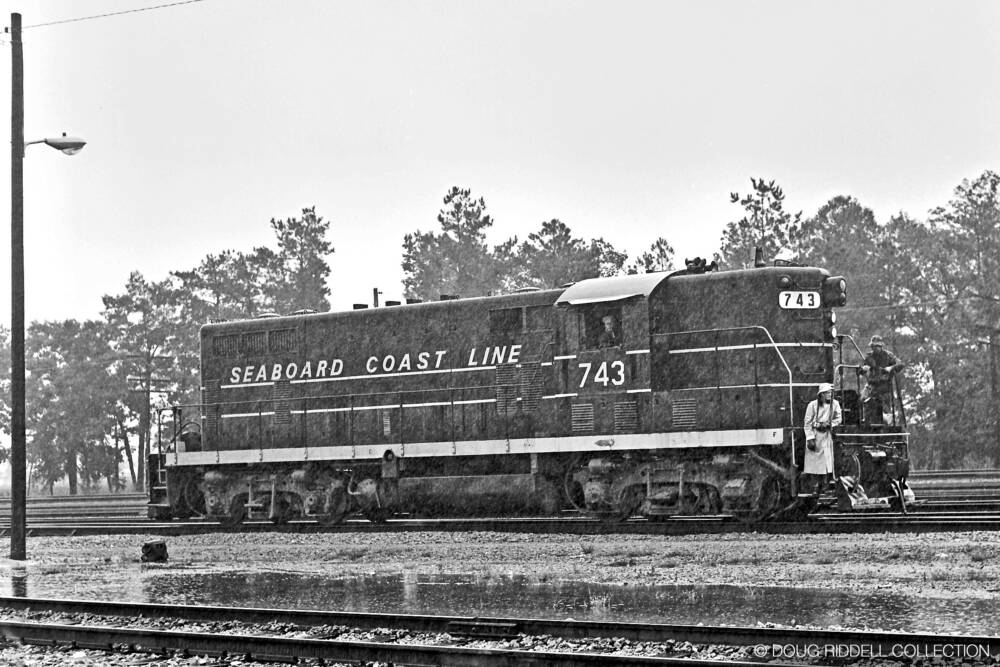
I’ve scoured railroads from coast to coast for nearly 50 years searching for the ideal image of this other side of railroading. The other day, I found the photograph I’ve always wanted to capture — one that exemplifies the daily life of the working railroader. It wasn’t from some scenic Rocky Mountain right of way, or the urban iron matrix of the northeast. It was snapped at a railroad yard where I had spent hours at the throttle of the very engine depicted. Working railroaders are seen, who looked very familiar, although I’m not sure if they were younger images of the same veterans with whom I later learned the ropes, or not. Yes, I found the image. However, I wasn’t lucky enough to have personally taken it.
The picture is made from a negative I purchased from an estate. It was taken by an unknown photographer at Collier Yard, Petersburg, Va., in October 1971. The brakeman and conductor, braving the elements in their bulky rain gear, are grimacing in the windy downpour as they move about, coupling, uncoupling, and sorting cars to be forwarded on through freight trains. Whatever the actual temperature is, due to the dampness and wind chill it surely feels 10 to 15 degrees colder. But the engineer sits fairly dry and reasonably warm in the locomotive cab. I’d run that same engine, 743, and thousands more before I retired. Believe me, there was no place better to be on days like this.
As a small child, I knew I wanted to be a railroader. Not long after I became a brakeman, I decided I might want to become an engineer. If a picture says a thousand words, this one surely explains why. When I was hired by the Seaboard Coast Line in 1977, it was explained that on the railroad, it never rained or snowed. There was no such thing as lightning or thunder. I’d work in the heat of day and the cold of night, 24/7, 365. I learned not to complain. What good would it have done anyway?
This article can also be read in February Trains 1,000th issue!
Share this article