INTERLAKEN, Switzerland — Lots and lots and lots of trains today — eight in all — to get from Montreux to Interlaken, but that’s because we didn’t take the fast route.
We took the high one, instead.
On the Trains/Special Interest Tours “Majestic Switzerland” tour, the journey from last night’s hotel to tonight’s was via the Jungfrau Railways, which takes you (as you are told many, many times) to “The Top of Europe” — the Jungfraujoch station, at elevation 11,333 feet (3,454 meters), the highest railway station in Europe. Even by the standards of Swiss cog railways, this is a particularly amazing engineering feet, because the final 4.5 miles are in a steeply inclined tunnel bored into the solid rock of the Jungfrau mountain. What’s more, this work was finished in 1912, completing a project conceived in 1893, with the beginning of construction in 1898.
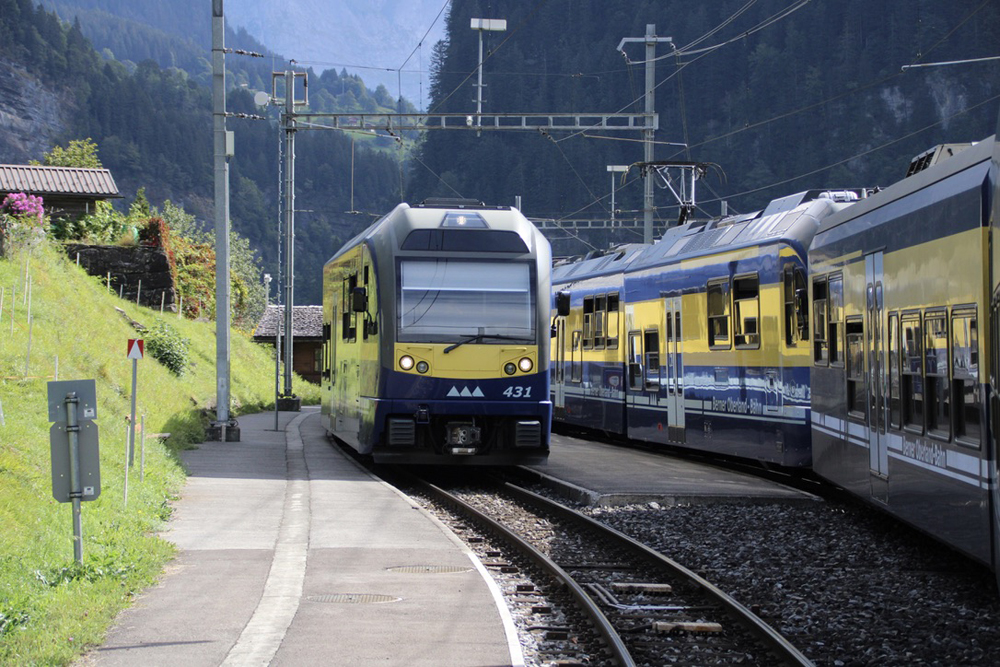
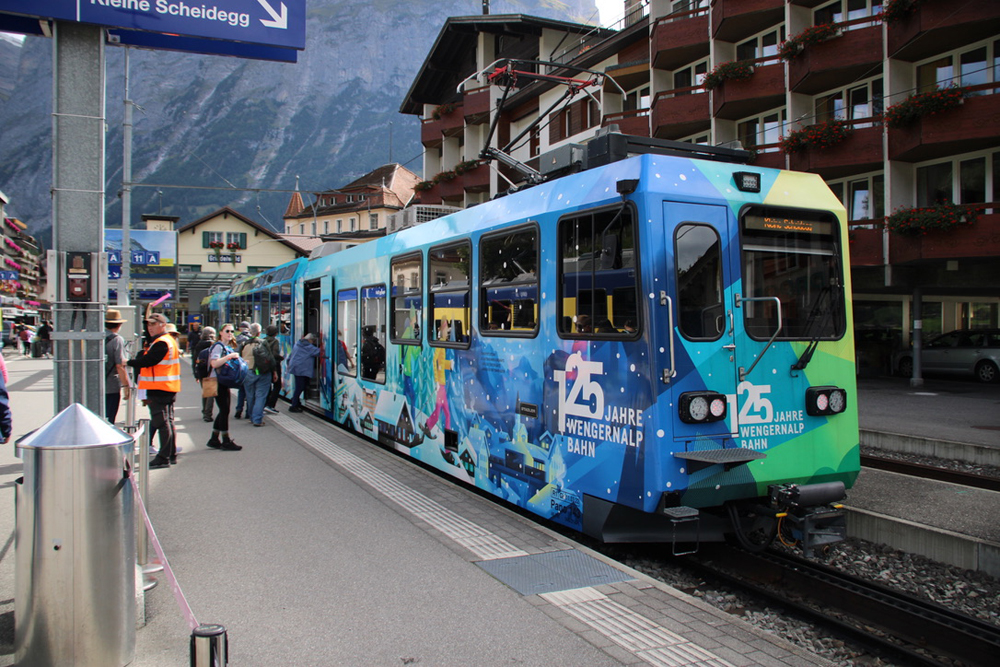
Out of Interlaken, we traveled on the meter-gauge Berner Oberland Bahn to Grindelwald. From there, we switched to the 800-millimeter gauge Wengernalp Railway to Kleine Scheidegg, where we switched back to meter gauge on the Jungfrau Railway. (Pay attention, there will be a quiz later.) The latter, featuring the 4.5-mile tunnel, is a mere 5.8 miles long, with a maximum grade of 25%. The long tunnel to the top includes a brief stop at Eismeer, where short tunnels take you to viewing windows in the side of the mountain. Good thing these exist: We still had a view there, but the top of the mountain was in a cloud that limited visibility to a few yards. Plus it was 32 degrees with sleet and 27-mph winds.
This is presumably not unusual, because there are a bunch of attractions built into the mountainside, as well. Mostly tacky ones, as far as I’m concerned (although I didn’t go into the Ice Palace, a tunnel through glacial ice that includes a number of ice sculptures and other features, and was told it was actually pretty good. Beyond that, there is shopping and several restaurants. None of which really are worth the cost of the ride (which is substantial) — but even with the destination socked in, the ride offers some amazing vistas, and I can imagine that if you hit a day with a clear view at the top, the payoff must be spectacular.
Even without stepping outside, spending time at 11,333 feet was not necessarily comfortable. Just walking up or down a flight of stairs left me short of breath, and by the end of our 2½ hours at the top, I was feeling a bit light-headed. Some of our tour members were uncomfortable enough that I made sure to know where I could find emergency assistance if needed. (Which, thankfully, it wasn’t). I was told that drinking lots of fluids — particulary something sweet, like orange juice — or eating chocolate is supposed to be a good idea while you’re at the summit. It’s definitely a know-your-limitations sort of activity.
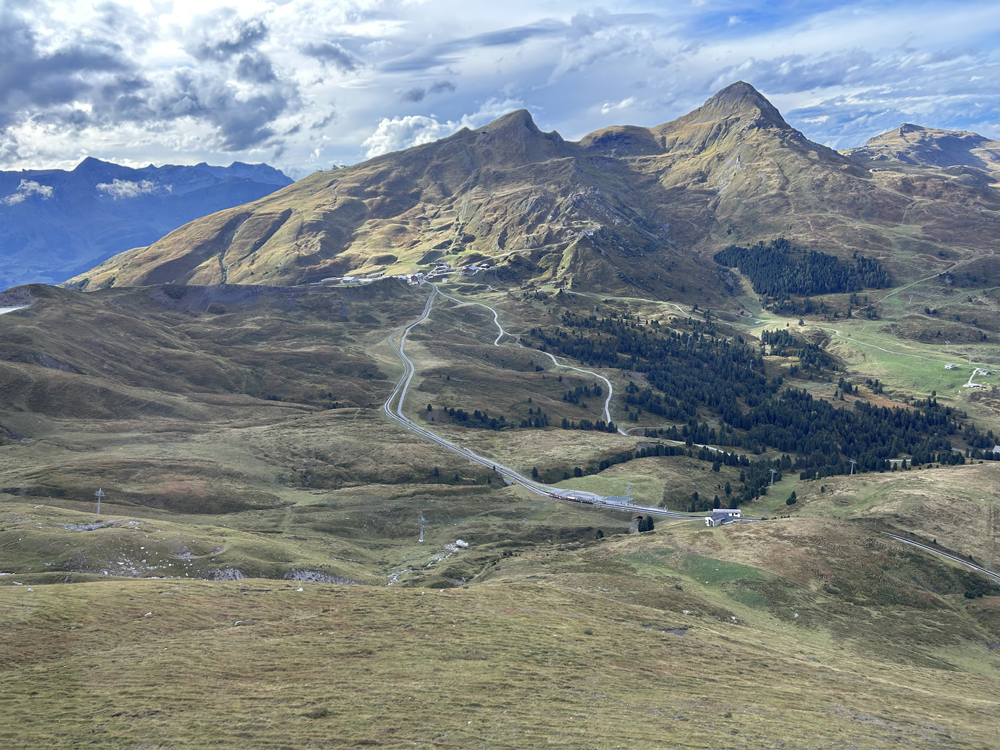
Coming back, we took a much faster route, using the Eiger Express gondola ride, which does in 15 minutes what the various rail lines require about an hour to accomplish. You could obviously shave a lot of time off the trip by using the gondola (which only dates to 2020) in both directions, but since this trip isn’t sponsored by Gondolas Magazine, we wanted to experience the rail route. (A few people chose to ride the train both ways, but most of us wanted to at least sample the gondola.)
This was the second time in three cog railway trips the tour has been skunked for a view at the summit, but my sense was that the group is still glad we made the ascent. And tomorrow’s another day — with another cog railway. But I’ll tell you about that then.
Share this article