


Meet the Enthusiasts
We are not alone, although it sure can feel that way. Many of us have, at one time or another, may have felt we needed to explain why we like trains and railroading. If we didn’t get the “look,” it was usually “Oh, you still play with trains?” After a while you just ignore it.
But, well, why not? As a hobby, it’s certainly no more unusual than collecting coins, stamps, or butterflies. But just when I felt we really did have an unusual hobby, I came across another that, to the public at large, may be considered just as unusual.
Guess what? They also don’t care what other people think.
I’m talking about plane spotters, and we have more in common with aviation enthusiasts than you might believe. I always knew of the existence of plane spotters; many are train enthusiasts as well. But in general, we prefer iron horses, and they are more attracted to machines that fly.
It all boils down to what we like to do when we have free time. For some it becomes an obsession, for others, it’s just an enjoyable way to take our minds off work.
Whether it be trains or planes, a hobby can also be a great social leveler, with membership cutting through all classes, professions, ages, and persuasions. When we get together it becomes an all-welcoming club where everyone can sit at the table. It’s a place where we feel comfortable just being ourselves.
You can see it wherever railfans gather: “Is that one of the new SD40 rebuilds?” Or “You should have seen this place when they had Baldwins.”
Until recently I never realized how similar train fans and airplane spotters are.
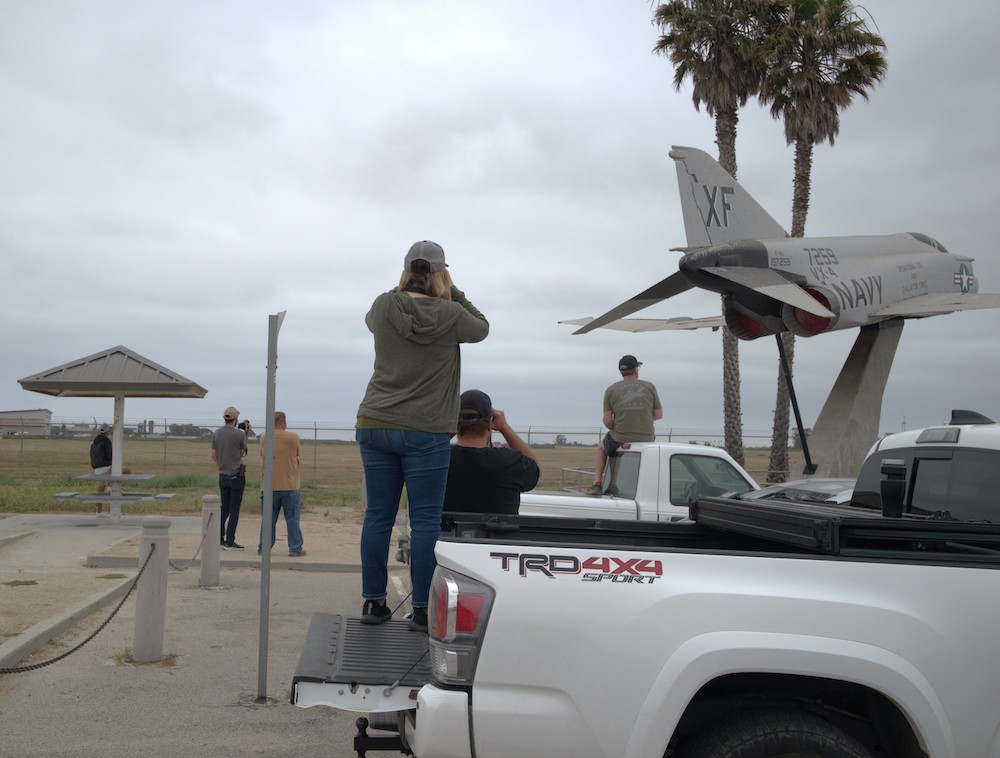
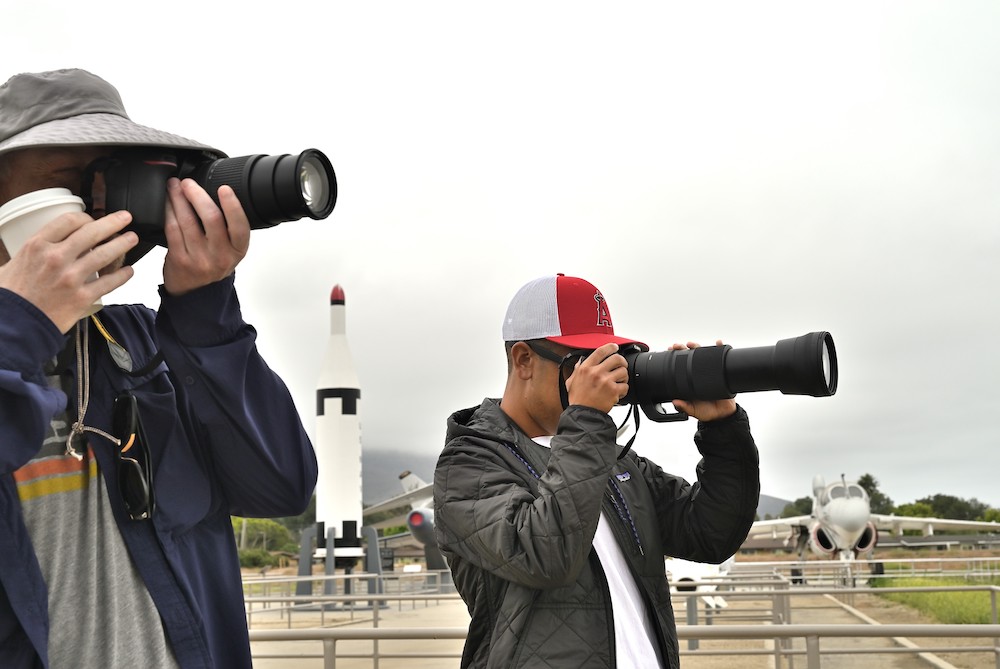
When I visited a U.S. Navy base, I found a small group of people milling around in a secure area near the end of one of the active runways. They had the same enthusiasm we have when watching trains. Except they were photographing aircraft.
“AWACS coming in!” yelled someone standing in the back of their pickup truck with a super long telephoto lens, his scanner crackling at his feet.
As the large airborne radar aircraft came closer to the runway where we were all standing, the air was quickly punctuated by the sounds of dozens of digital cameras set on continuous as it went by. The dozen or so fans, most sporting monstrous zoom lenses, photographed its every move.
“It just came in from Tinker,” someone yelled over the jet noise, meaning the AWACS official home base of Tinker Air Force Base in Oklahoma City. “It’s here for a multi-service exercise.”
“Was that an E model?” someone else asked. “Nah, I think it was a D. I’ll check the tail number.”
The nomenclature was foreign, but the knowledge was the same. Substitute a rail yard and the questions might have been about the difference between a GP38 and a GP39.
It was obvious I was not a regular, but I was quickly accepted into the group. There were a couple of local jocks, a few ex-service members, a father who brought his young daughter, and a group of high school and college types hauling around enough photographic gear to stock a camera store.
“New here?” a fan asked me. “Best time to see lots of action is early morning between 8:30 and 10.” Some of the others chimed in to confirm his comments.
“Any time I see an F35 take off I get goosebumps,” said John, who had arrived before dawn to see the show. “If I’m not here I like to go watch trains, especially farther up the coast towards Santa Barbara.”
The scanner crackled again with a voice from the tower authorizing a California Air National Guard C130J Super Hercules to take off. Everyone peered down the runway and photographed the takeoff with the same enthusiasm as if it was the sleekest fighter jet.
“Love the J model,” someone commented. “I remember when these guys flew the original Hercules and before that the Boeing C97. Now that was a cool aircraft.”
Among the fans was one particular clean-cut young man waiting patiently to see a Boeing C17 Globemaster III, one of the U.S. Air Force’s heavy-lift cargo jets.
“My name’s Chris,” he said promptly, thrusting out his hand.
We chatted briefly in between airplane landings. Chris, I found out, was in the Air Force, and currently attending flight school. By the time you read this, he’ll be in advanced training on the Raytheon T6A Texan II boring holes in the skies above Enid, Okla.
“I’m hoping to qualify for C17s,” Chris said. “They’re awesome.”
As I was leaving, I wished Chris good luck and wondered if he would want to know what railroads went through Enid. I thought the better of it, though; I’d let him find out for himself.
A few fans had to go to work or school and packed up their gear, with one saying he was going to Oxnard to see if there was anything at the Union Pacific yard or the Ventura County Railroad.
Shortly after, as I watched the end of the runway getting smaller in the rearview mirror of my car, I came to the realization that, as fans of big, mechanical things that move, we are not alone.