

I’m heartened to see Amtrak intends to explore a 200-mph Dallas-Houston passenger rail service in cooperation with Texas Central Partners. Having driven I-45 between the two megacities, I can vouch for its clear need and likely success.
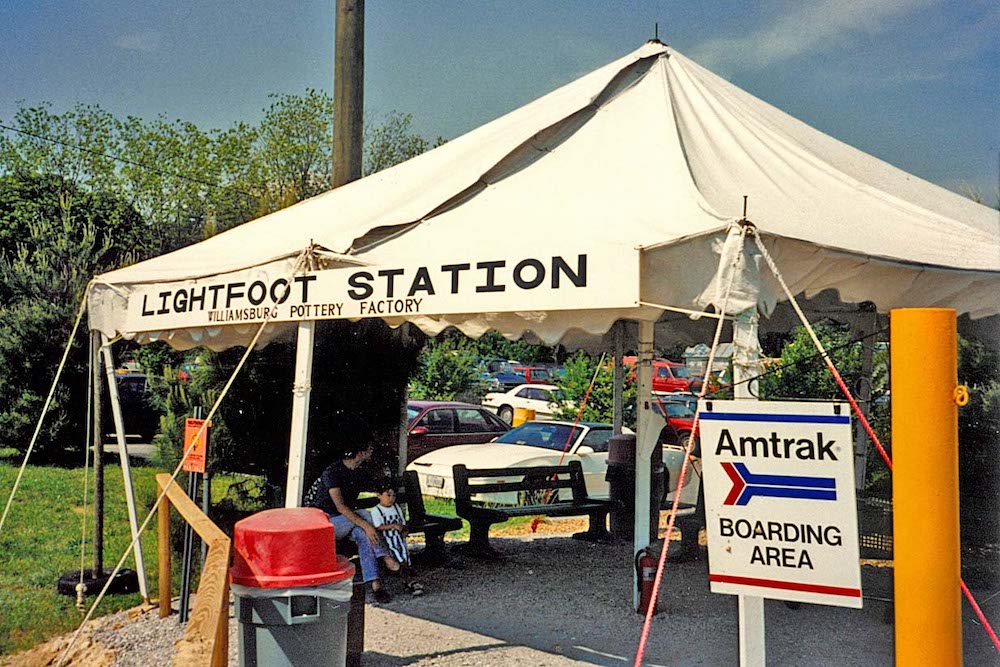
Not all of Amtrak’s plans have succeeded as envisioned, unfortunately. One, in particular, comes to mind: the short-lived (May 2, 1993 to April 4, 1996) flag stop at the Williamsburg Pottery Factory, just 5 miles west of the meticulously restored Colonial Capitol of Virginia.
The Pottery opened in 1938 as a kiln, where local artisans created Colonial American style pottery, later adding shops where they could sell their wares. By the 1960s it had expanded to become a pre-outlet mall shopper’s dream — endless acres of free parking surrounding buildings filled with jaw-dropping bargains. Giddy shoppers spent the day there, filling the trunks of their automobiles with everything from decorative brass door knockers to concrete statuary. The Pottery’s “Skid Row” further marked down everything from NFL jerseys to Lionel trains. Tourists carted off their priceless treasures — usually leaving behind a sizable chunk of change.
In its heyday, The Pottery was promoted by Virginia officials as one of the most-frequented tourist draws in a state containing hundreds — if not thousands — of historic attractions. A 1990 estimate boasted that three-million visitors entered its gates annually.
Figures don’t lie, but taken at face value, they’re often misinterpreted. Amtrak opted to make The Pottery a flag stop for its Boston-Newport News Colonial trains 95/94 (at the time, the sole weekday scheduled train between Richmond and Hampton Roads). Nicknamed “the shoppers’ express.” The Colonial continued to serve tourists and William & Mary College students, using the stately brick Chesapeake & Ohio-built Williamsburg depot, footsteps from the historic district.
As the train’s engineer, I remember only one occasion when we stopped at The Pottery’s flag stop to board or detrain anyone. He was a local restaurant owner who intended to get off there on Tuesdays, to prepare his weekly payroll overnight. After my conductor thanked him for traveling Amtrak, tossed the yellow step box up into the vestibule, and gave me “two to go” on the communicating signal, our passenger discovered The Pottery was closed and its exit gate was locked. No one could get in and he couldn’t get out.
The following morning, he angrily recounted how he ripped his trousers escaping over the tall chain-link fence. Amtrak apologetically paid for a taxi to bring him to the Williamsburg station. I’m not sure about his pants.
In retrospect, no one apparently took into account that the weekday southbound Colonial arrived after The Pottery closed, and its northbound counterpart passed through before the first morning shoppers arrived.
I feel fairly certain Dallas and Houston are both open 24/7. At least, I hope so.
Share this article