

WASHINGTON — A federal court has struck down the Surface Transportation Board’s approval of the Uinta Basin Railway project, calling the decision allowing its construction “arbitrary and caprious.” The court also vacated the Environmental Impact Statement and a related document underlying that decision and sent the matter back to the STB.
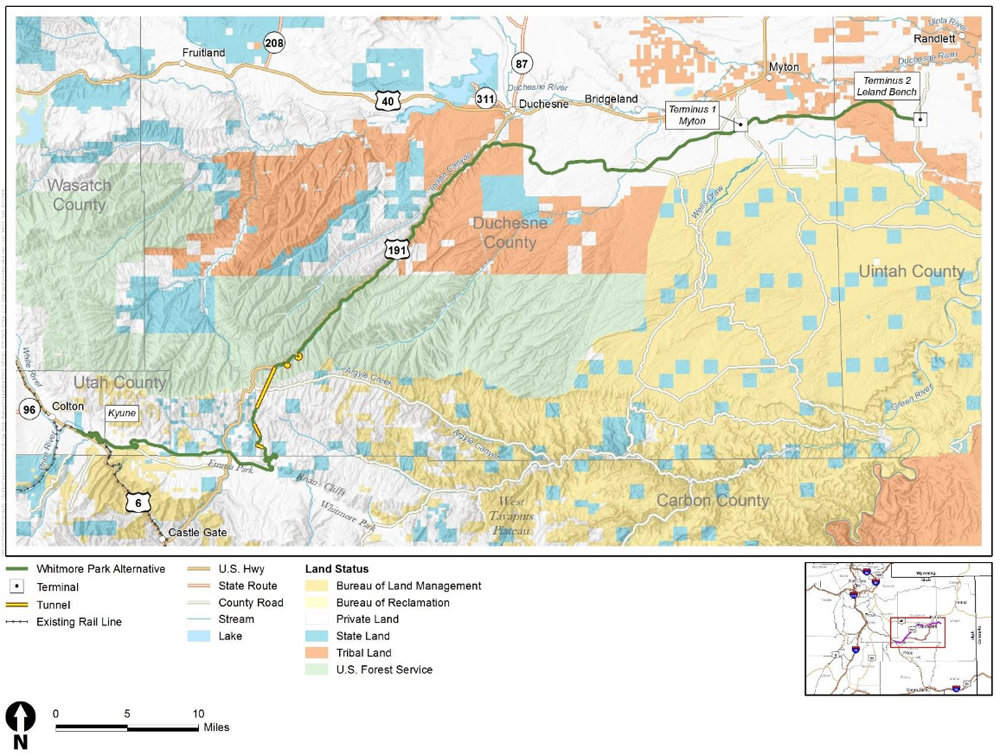
In granting the exemption sought by the coalition allowing construction of the 88-mile rail line in eastern Utah, the board had said the project “is likely to produce unavoidable environmental impacts” but that “the transportation merits … outweigh the environmental impacts” [see “STB clears path for Uinta Basin Railway project,” Trains News Wire, Dec. 16, 2021].
 But Friday’s ruling from the U.S. Court of Appeals for the District of Columbia — in a suit brought by Eagle County, Colo., and several environmental groups against the STB and Seven County Infrastructure Coalition, the group seeking to build the railway — said the court found the environmental report from the STB’s Office of Environmental Analysis “failed to demonstrate that the Board took the requisite ‘hard look’ at all the environmental impacts of the Railway.”
Opponents of the project hailed the ruling.
Eagle County Attorney Bryan Treu told the Colorado Sun the board “cut corners in their environmental analysis of this project, particularly as it relates to Colorado, and now they have to start over.” Deeda Seed of the Center for Biological Diversity, another of the plantiffs in the case, said in a press release the decision was “an enormous victory for our shared climate, the Colorado River, and the communities that rely on it for clean water, abundant fish, and recreation.”
Meanwhile, the Seven County coalition, in a joint statement with its financing partner, DHIP Group, told the Salt Lake Tribune it was “ready, willing, and capable” of working with the STB “to ensure additional reviews and the project’s next steps proceed without further delay. We look forward to bringing this railway to the basin.”
STB spokesman Michael Booth told the Associated Press the agency does not comment on pending litigation.
The decision by the three-judge panel was critical of the failure to consider impacts of the project beyond its immediate area, saying it agreed with the plaintifs’ contention that the final environmental report “ignored certain upstream and downstream impacts.” Specifically, the court faulted the board’s failure to consider the larger environmental impacts of the oil drilling in the Uinta basin, and from the later refining of that oil.
The board argued in part that such impacts “are not reasonably foreseeable,” and in part that it was not required to consider environmental impacts of refining because it “cannot regulate or mitigate” such impacts.
But Judge Robert L. Wilkins, writing for the panel that also included Judges Patricia Millett and Cornelia Pillard, rejected both arguments.
On the first point, he wrote, “The Board provides no reason why it could not quantify the environmental impacts of the wells it reasonably expects in this already identified region. Further, the Board’s cursory assertion that it could confine the upstream impacts of oil
development on vegetation and wildlife to areas where oil development and railroad construction would overlap lacks any reasoned explanation and is unsupported in the record.”
On the second, he wrote, “the board “cannot avoid its responsibility under [the National Environmental Policy Act] to identify and describe the environmental effects of increased oil drilling and refining on the grounds that it lacks authority to prevent, control, or mitigate those developments. … (G)iven that the Board has the authority to deny an exemption to a railway project on the ground that that railway’s anticipated environmental and other costs outweigh its expected benefits, the Board’s argument that it need not consider effects it cannot prevent is simply inapplicable.”
The court also found the environmental report failed to provide the required “hard look” because it did not consider the increased risk of a rail accident or wildfire downline because of increased rail traffic, or the impact on water resources resulting from such events.
That concern over downstream impacts, particularly the risks resulting from an accident involving a train transporting oil from the Uinta Basin project along UP’s mainline through the Colorado Rockies, was a primary point of contention for Eagle County.
The lack of scope played a similar role in the court vacating the Biological Opinion on potential impacts on endangered species and critical habitats was a part of the environmental report.
In that regard, Wilkins wrote, “The Board’s reasoning for narrowly defining the action area not to include waterways downline near the Union Pacific Line is unreasoned and fails to demonstrate a ‘rational connection between the facts found and the choices made.”
The 627-page environmental report, accompanied by almost 2,300 pages of appendices, was issued in August 2021.
— Updated Aug. 19 at 8:45 p.m. with comment from Seven County Infrastructure Coalition.
Share this article