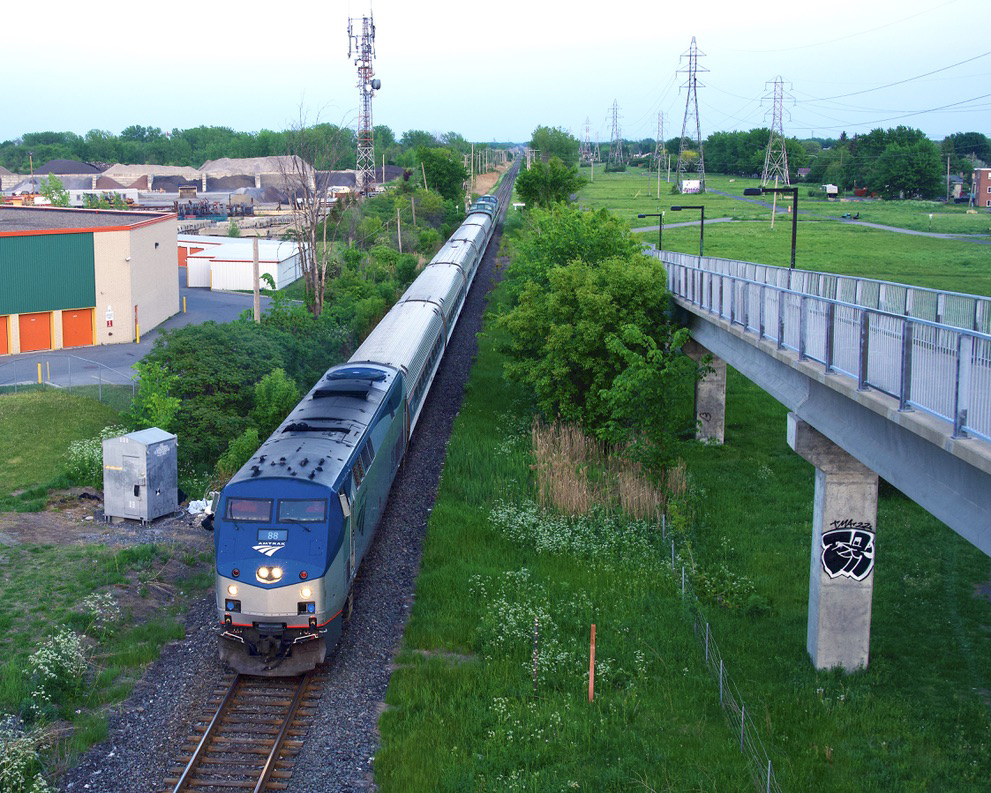
MONTREAL — Canadian National says the 10-mph restriction it imposed on Adirondack operation between the Canadian border and Montreal during temperature extremes is a direct result of Amtrak’s unwillingness to pay for the level of track maintenance CN says is necessary to maintain passenger train speeds.
That is according to a statement issued in response to a Trains News Wire inquiry regarding responsibility for Amtrak’s decision to cancel its daily New York-Montreal train north of Albany-Rensselaer, N.Y., beginning June 24 [see “Amtrak abruptly suspends ‘Adirondack’ …,” News Wire, June 26, 2023]:
“The safety related speed restrictions are due to weather conditions in Southern Quebec and apply to passenger and freight service. Based on track standards, railroads apply speed restrictions during extreme heat and cold weather episodes as the rail is subject to expansion and contraction due to ambient temperature.
“Amtrak is responsible and has failed to pay for the maintenance required to keep the track at a level that accommodates its service. If Amtrak agrees to make that investment, CN could upgrade the track to a level that would reduce heat restrictions.
“CN cannot comment as to why Amtrak is refusing to invest into this segment of track to reduce the impact of extreme weather conditions or why Amtrak is not placing adequate crew levels on this route to ensure that passengers can get to their destination.”
Track maintained to higher tolerances permitting less deviation isn’t subject to gauge variation during the expansion and contraction. The reference to the lack of “adequate crew levels” apparently notes that as staffed, engineers and conductors can’t complete runs without exceeding maximum on-duty hours-of-service limits.
Amtrak claims CN inconsistently applies heat orders
Asked late Wednesday to respond to CN’s contentions, Amtrak said in a Friday morning statement that it is current on payments with CN, but Adirondack service to Montreal was terminated because uncertainty surrounding the host railroad heat order policy could lead to stranded passengers:
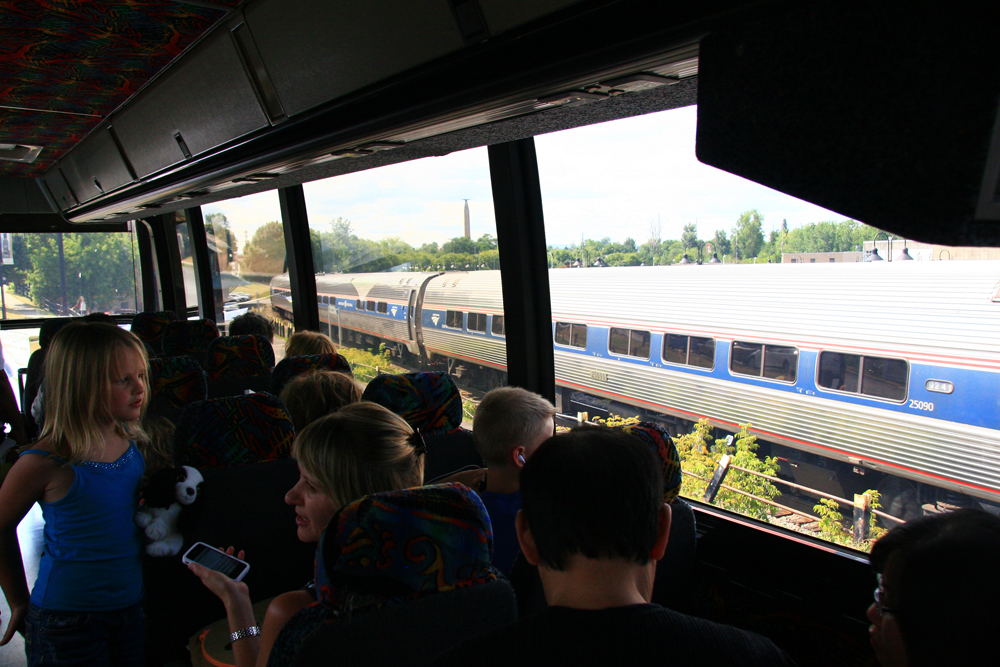
“As part of our agreed-upon contract, Amtrak has been fulfilling all of its financial commitments and obligations, including payments totaling $3.2 million to Canadian National since the border reopened, to help prepare for resumed Adirondack service. We have recently seen an inconsistent application of CN’s historical heat order policy, and are concerned that if we continue to operate trains, there’s potential our customers could be stranded in place or add two and a half to three and a half hours of delays during their trip. We are continuing our conversations with CN and exploring all possible solutions with New York State and look forward to resuming Adirondack service north of Albany.”
Freight needs dictate track conditions
Although Amtrak says money is not an issue, the Adirondack situation reflects Amtrak’s historic reluctance to pay for a level of track utility greater than what the host railroad’s freight traffic requires.
The Broadway and Capitol Limited reroute away from Fort Wayne, Ind., in 1990, and the Sunset Limited’s exit from Phoenix in 1996, are a direct result of decisions by Conrail and Union Pacific, respectively, to downgrade routes Amtrak had utilized through those cities. Amtrak could have maintained service if it had been willing to fund incremental track investment expenses. The company’s proposal to replace the Southwest Chief with buses over a mid-route segment in 2018 was likewise driven by potential cost savings if a passenger-only segment was abandoned.
In this case, the major Canadian-U.S. freight conduit through Rouses Point and Plattsburgh, N.Y., belongs to Canadian Pacific, whose tracks continue north of the border. Delaware and Hudson’s pre-Amtrak Laurentian and overnight Montreal Limited utilized CP subsidiary Napierville Junction Railway to serve CP’s Windsor Station in Montreal. The Adirondack switched to Canadian National because it could use most of the same route hosting Amtrak’s now-discontinued Montrealer, operating in the U.S. over the CN-controlled Central Vermont, to serve CN’s Central Station in Montreal.
New England Central, CV’s successor, remains CN’s principal U.S. freight partner in the region, and north-south freight traffic using that route can run at slower speeds and at night when heat restrictions aren’t an issue.
Pre-clearance inaction
Track upgrades north of St. Albans, Vt., and past the connection with the Adirondack route at Cantic, Quebec, would be necessary if the state-sponsored Vermonter is extended to Montreal, but that initiative won’t proceed until a customs pre-clearance facility is built at Montreal’s Central Station. This would obviate the need for two-hour border stops that currently plague the Adirondack, but not intercity bus passengers. U.S. Sen. Peter Welch (D-Vt.) questioned Amtrak board chairman Anthony Coscia about efforts to develop the pre-clearance facility during a hearing earlier this month [see “Senators remain concerned about geographic balance …,” News Wire, June 21, 2023].
During the train’s COVID-19-triggered three-year hiatus, Trains News Wire repeatedly asked Amtrak and the New York Department of Transportation, the train’s financial sponsor, who was taking the lead on pre-clearance negotiations with Central Station’s current owner, Colmenar REIT. Both declined to respond. Questions why it was taking so long to reinstate the Adirondack were also not answered.
It is now clear that neither New York’s DOT nor Amtrak chose to address the track maintenance issue or contingency plans to transport passengers before CN imposed the current restrictions.
Renewed political concern
During the Adirondack’s long absence, U.S. Sens. Charles Schumer and Kirsten Gillibrand (both D-N.Y.), as well as U.S. Rep. Elise Stefanik (R-N.Y.), frequently raised questions about the situation. Similar concern is now being raised by New York Assembly member Angelo Santabarbara (D-Schenectady). Santabarbara has written Amtrak CEO Stephen Gardner urging that service be offered “to Saratoga Springs and potentially Plattsburgh until the dispute with Canadian National is resolved.”
As of Thursday afternoon, Amtrak’s website showed the train is cancelled in both directions through July 10. The temperature in Montreal reached 30 degrees Celcius (86 Fahrenheit) — the point triggering 10-mph operation — on June 26, and is predicted to do so again July 8. But otherwise, temperatures are projected to remain below that threshold.
— Updated June 30 at 11:05 a.m. CDT with Amtrak statement
Share this article