

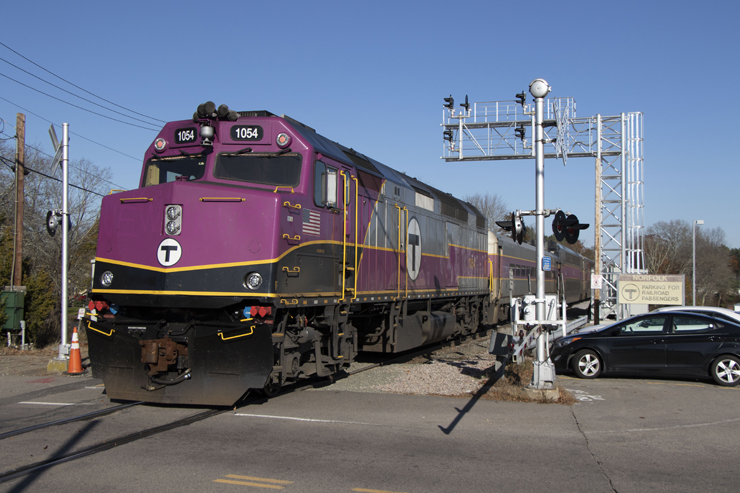
BEVERLY, Mass. — A lawsuit filed Monday seeks to do away with quiet zones at pedestrian crossings in Massachusetts, an effort that pits safety concerns against quality-of-life issues in the state.
The Boston Globe reports the suit was filed by Mark Layman, a former MBTA locomotive engineer whose train killed a teen walking along the tracks in 1999, and Peter Brown, a lawyer whose friend was killed at a pedestrian crossing in Beverly in 2019. They are asking a justice of Massachusetts’ highest court, the Supreme Judicial Court, to find that the quiet zones are not permitted under state or federal regulations.
Brown has been motivated by the death of Emerson College professor Moses Shumow, killed in October 2019 when he was struck while riding his bike across tracks at the Beverly depot — a death which has also led to a suit questioning the safety of quiet zones created by the city of Beverly [see “Suit says city’s ‘quiet zone’ created unsafe situation,” Trains News Wire, Sept. 30, 2022]. Beverly has five quiet zones, the Globe reports, more than any other Massachusetts municipality.
But the suit, if successful, would impact as many as 25 communities along MBTA commuter rail lines. Geoff Beckwith, executive director of the Massachusetts Municipal Association, told the Globe loss of the quiet zones would be “extremely disruptive …. You would have entire neighborhoods where the quality of life would be impacted. This would affect hundreds of thousands of people.
“It’s terrible these tragedies occur, but there’s always a balance.”
The Globe reports that while the Federal Railroad Administration approves quiet zones, Massachusetts’ Department of Public Utilities regulates grade-crossing safety in the state, and state law requires trains to sound their horn at least a quarter-mile before reaching a pedestrian crossing. The DPU says it has “limited oversight” but the FRA has jurisdiction over horn use. A spokeswoman for Keolis, contract operator of the MBTA commuter rail network, said no federal regulation requires horns to be sounded at pedestrian crossings.
Share this article