

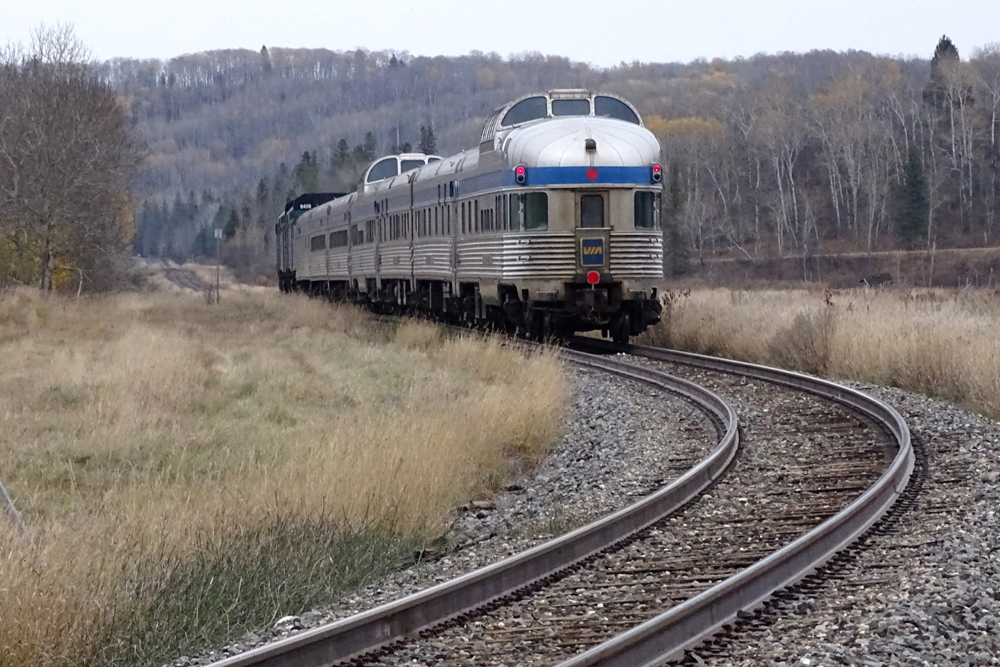
MONTREAL — An independent consultant’s inspection requested by VIA Rail Canada management has prompted the company to immediately assign non-revenue buffer cars at the rear of all trains that utilize HEP-1 and HEP-2 stainless steel equipment manufactured more than 60 years ago.
The action was taken unilaterally by VIA last week as a safety precaution, pending further examination by the Transportation Safety Board of Canada and a series of more in-depth tests. Sources tell Trains News Wire that no single incident led to the company-wide inspection. But there have been isolated instances over the last several decades where cars built by the Budd Co. and other U.S. manufacturers, primarily in the 1950s, have occasionally displayed structural defects during periodic heavy overhauls.
The coaches, sleeping cars, dining cars, and dome-lounges are currently mainstays on the Toronto-Vancouver, British Columbia, Canadian, as well as Winnipeg-Churchill, Manitoba, and northern Quebec remote-service trains. Six consists operating in the Quebec-Montreal-Ottawa-Toronto-Windsor corridor also have this equipment, as does VIA’s Montreal-Halifax, Nova Scotia, Ocean.
The HEP-1 cars debuted on Canadian Pacific’s transcontinental Canadian and Dominion in 1955; the HEP-2 designation was applied to other stainless steel cars acquired from Amtrak and other U.S. roads that were modernized by VIA in the early 1990s.
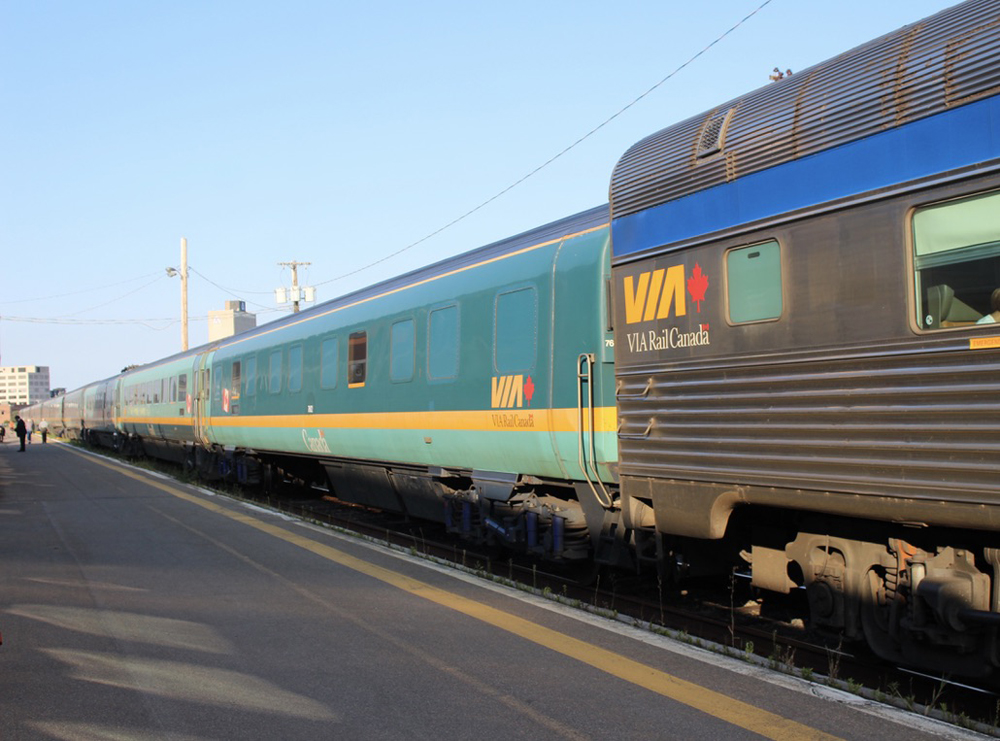
The Ocean has been running for more than a decade with an unmanned, mid-train buffer car between its European Renaissance equipment and Budd-built HEP-1 Park dome-observation-lounges. This is because the Renaissance cars are much lighter, and their different end-of-car profile might lead one car to telescope another in an accident. The observations were recently withdrawn when the train lost use of a wye to turn it at Halifax, but Renaissance buffers remain as stainless steel coaches and Chateau sleeping cars were added for flexibility and capacity.
Baggage cars are also at least temporarily off-limits. VIA issued an advisory stating that, “due to temporary operational adjustments, pets are no longer accepted onboard our baggage cars, as those cars will not be accessible to passengers during their journey.” This may pose a major inconvenience to remote-service travelers; pet transport on those routes is widespread.
The stainless steel cars singled out for rear-end protection were manufactured to withstand end-of-car buff strength forces of more than 800,000 pounds. The 1945 regulation was recently revised in the U.S. by the Federal Railroad Administration to account for passenger protection in an accident, rather than only measuring the horizontal impact on a car’s underframe. The rule therefore permits operation of lighter high-speed trainsets.
Renaissance cars have never complied with the buff-strength standard. They operate under a waiver, granted because the equipment was constructed with non-occupied crush zones at the end of each vehicle.
VIA is already short of rolling stock as it awaits the arrival of the Siemens Venture trainset fleet, so a wide variety of unoccupied cars has been pressed into service. This includes empty LRC coaches, recently seen bracketing HEP cars on the corridor.
Trains News Wire expects VIA Rail Canada and the Transportation Safety Board to provide details on the next steps.
Share this article