CHICAGO — Amazon’s move to increase control of its domestic supply chain by purchasing additional 53-foot intermodal containers could be a pivot-to-growth story for U.S. Class I railroads in the years ahead.
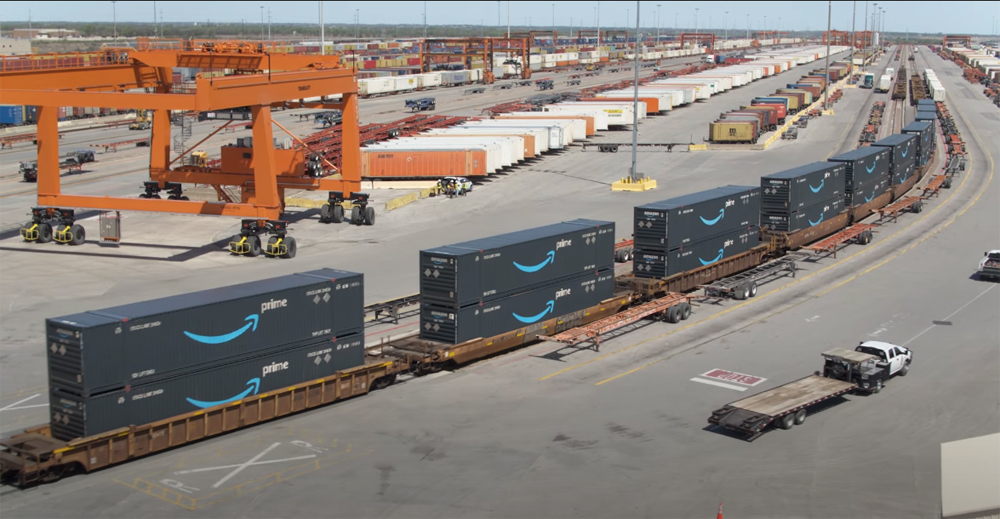
The online sales giant has grown its container fleet from 250 containers in 2019 to more than 5,000 today. That’s the equivalent of 36 miles of double-stacked intermodal trains branded with Amazon’s prime arrow on navy blue containers.
The retailer’s investment in its domestic intermodal program has reduced the number of containers it needs from intermodal providers such as J.B. Hunt or the Hub Group, meaning to some extent, Amazon packages have simply moved from those containers to its own. But few companies have scaled at Amazon’s pace, and its decision to invest in intermodal logistics exerts greater control over its supply chain process and creates capacity that could drive volume growth for railroads. The company’s commitment to achieving zero net carbon emissions by 2040 further supports a closer bond between railroads and e-commerce, as rail is generally viewed as four times more fuel efficient than moving freight on highways.
Intermodal analyst Larry Gross says retailers who own equipment and deal directly with U.S. intermodal rail are a revolutionary development. Historically, retailers have relied on logistics middlemen to coordinate this aspect of the business, keeping shippers from short-circuiting the process and dealing directly with railroads.
“Walmart and Amazon have so much clout, they forced it,” Gross says.
Amazon also sees its containers as marketable assets, diversifying its role as a logistics provider as it looks to build density. In July, Amazon opened its intermodal network to other shippers, allowing companies to use its containers [see “Amazon opens its intermodal network …,” Trains News Wire, July 22, 2022]. This could be a catalyst for creative growth opportunities between Amazon, its partners, and rail.
According to supply chain consultant MWPVL, Amazon has more than 1,200 facilities and 393 million square feet of capacity in the U.S., with an additional 99 million square feet of capacity planned. A quick analysis confirms a correlation between Amazon fulfillment centers and nearby rail intermodal terminals. In the West, a significant number of Amazon’s fulfillment centers are within 25 miles of BNSF Railway or Union Pacific facilities. CSX Transportation and Norfolk Southern facilities are near a number of Amazon hubs in the East.
While Amazon’s current fleet may represent just 5% of J.B. Hunt’s 100,000 containesr, the company is taking intermodal logistics by the reins. As it gains market share, it should be able to strengthen its negotiating leverage with favorable freight rates and premium service. It’s becoming increasingly possible to foresee the day when a high-priority Z train on BNSF’s Southern Transcon sports an all-Amazon container consist.
Share this article