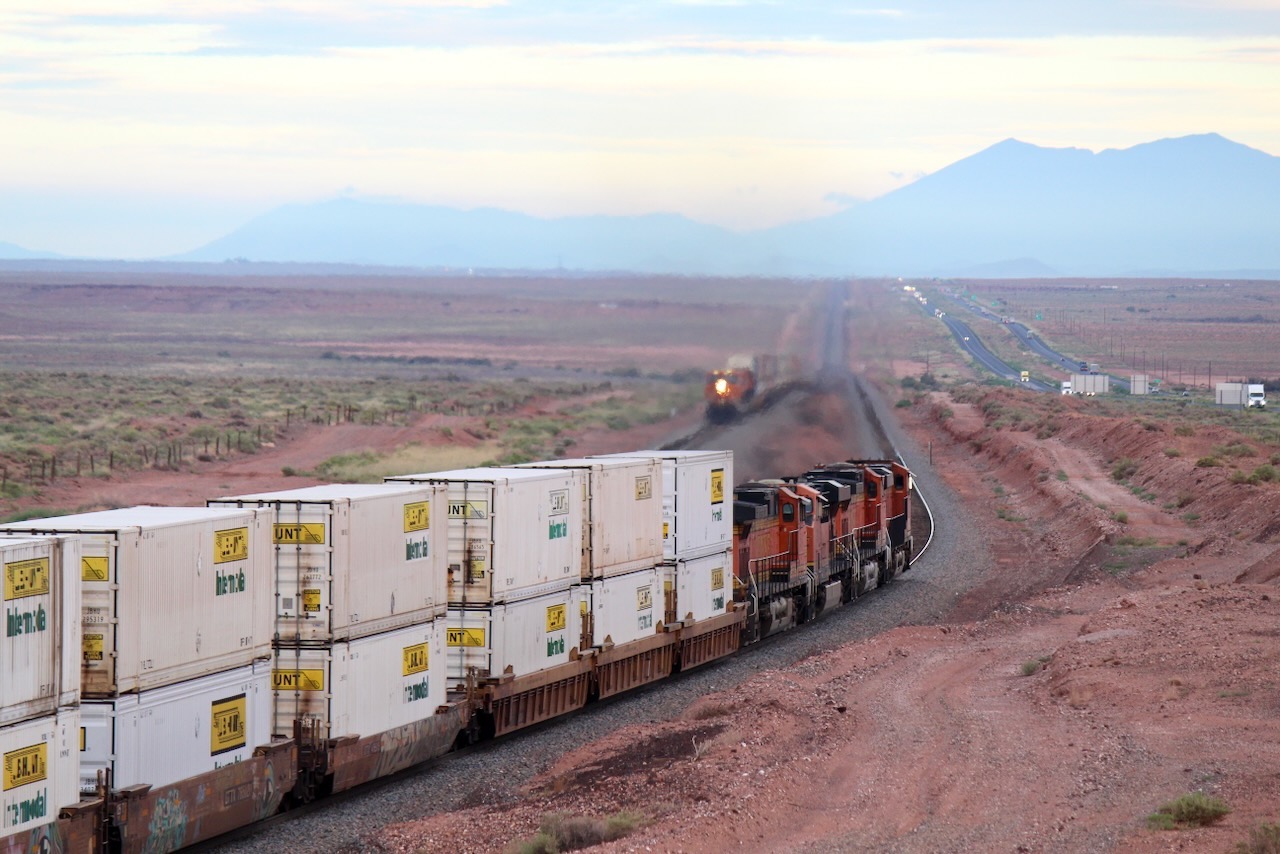


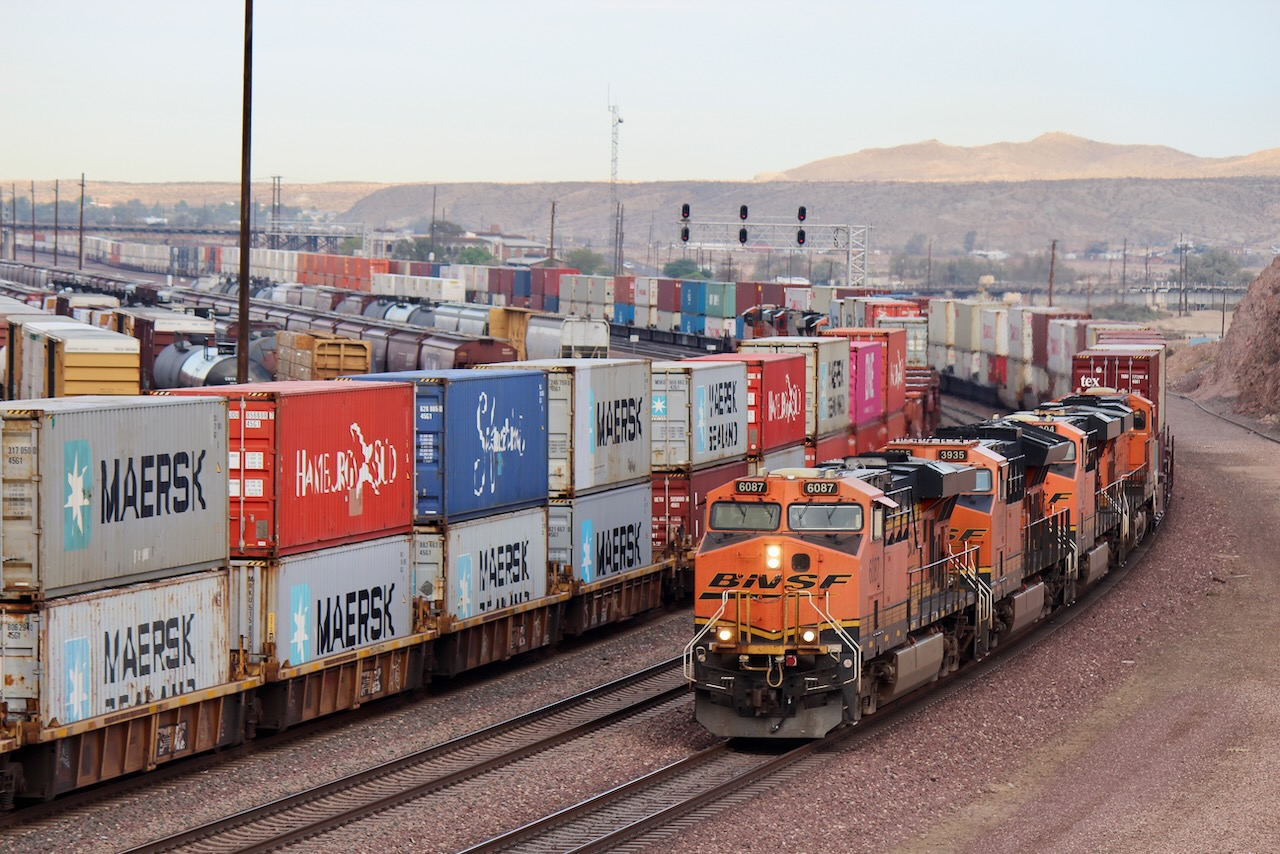
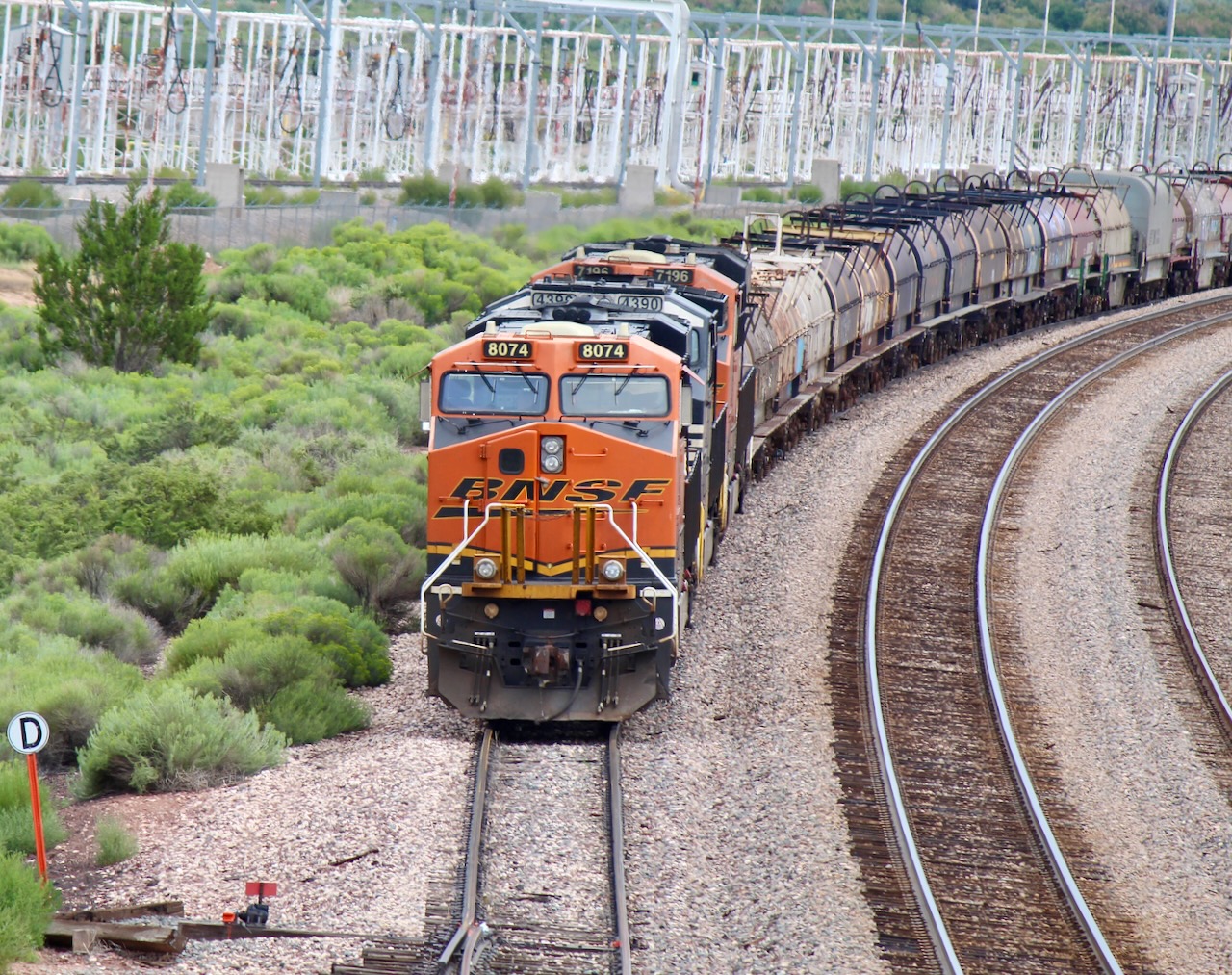
Earlier this month, Trains drove alongside BNSF Railway’s Southern Transcon from Barstow, Calif., to Belen, N.M., to see how North America’s busiest freight railroad and intermodal corridor is faring amid the crew shortages that have affected operations. BNSF’s California and Southwest divisions have been among the hardest hit in the country as the big four U.S. Class I railroads aim to replenish train crew staffing levels. An in-depth feature on the impact of crew shortages will be published in an upcoming issue of Trains.
Amid crew shortages and a supply chain that has almost as many kinks as links, BNSF Railway’s Southern Transcon across the Southwest is two railroads wrapped up in one.
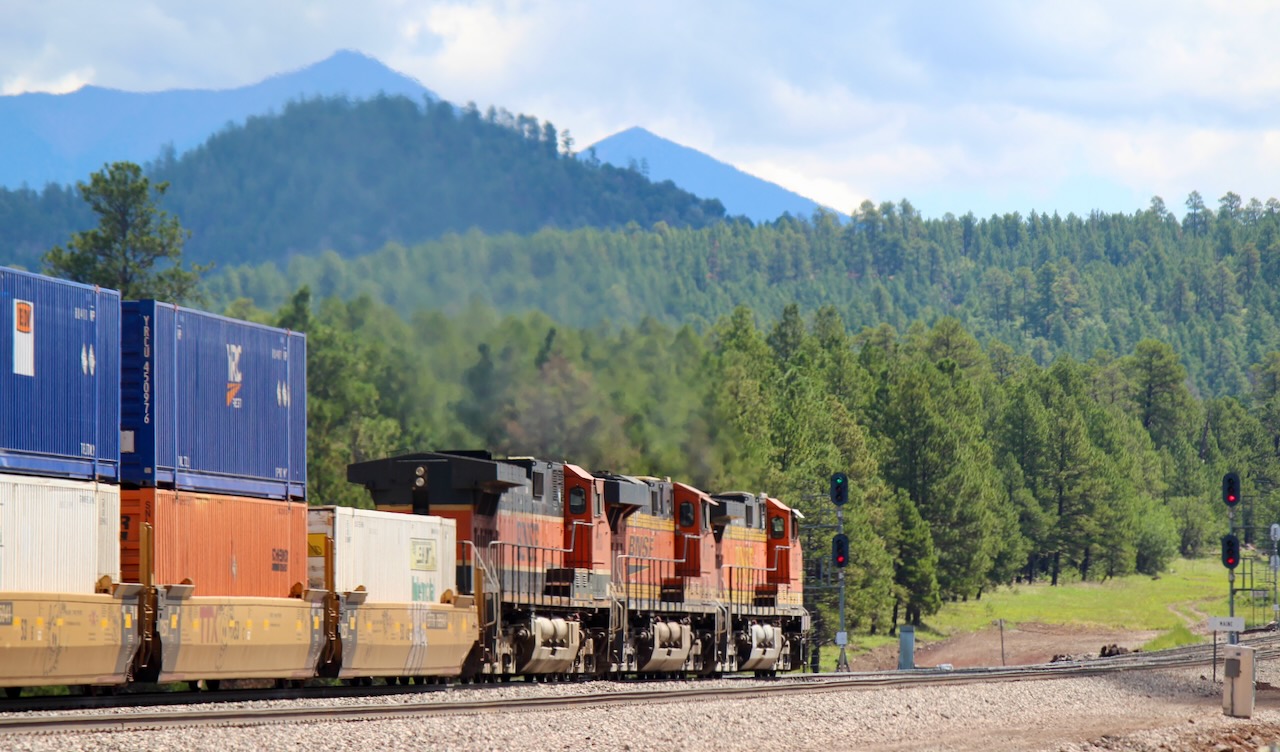
The first railroad you already know: It’s the intermodal artery that carries a fleet of priority Z-symbol hotshots and Q-symbol guaranteed-service stack trains. From trackside, they seem to be relatively immune to the railroad’s operational problems. While approaching Winslow, Ariz., on Interstate 40, you look across the sagebrush and glimpse eastbound and westbound intermodal trains rolling along at track speed, closing in on each other at a combined 140 mph. And crew changes are snappy, with fresh crews at the ready and highballing the trains out of town, often in 10 minutes or less.
The second railroad isn’t moving well — and sometimes isn’t moving at all. In old passing sidings from Barstow to Belen sit woebegone merchandise and international S-symbol stack trains. Some have been stripped of their locomotives and have been idle for days, or even a week or more. Lower-priority international intermodal, merchandise, and bulk trains also tend to congregate in and around terminals when rested crews are not available to take them on the next leg of their trips across the former Santa Fe main line.
The merchandise trains are tied down because scarce crews are being allocated to service-sensitive intermodal trains, a practice other railroads are following, too. BNSF’s unusual embargo on certain types of carload traffic bound for California, which began June 27 and will end Sept. 5, also plays a role as the railroad works off a backlog of traffic in Southern California.
The eastbound international stack trains, carrying containers imported through the ports of Los Angeles and Long Beach, are in a holding pattern. They’re awaiting space at clogged intermodal terminals in Chicago, Memphis, Kansas City, and Fort Worth.
Simply put, supply chain problems beyond BNSF’s control mean that volume is coming into the ports faster than cargo owners are picking up their freight at inland terminals. So those S-symbol trains – two dozen or more scattered between California and Chicago – are marooned until they are able to leapfrog closer to their destinations. As the No. 1 international intermodal carrier by volume, BNSF is far more affected by this phenomenon than the other railroads.
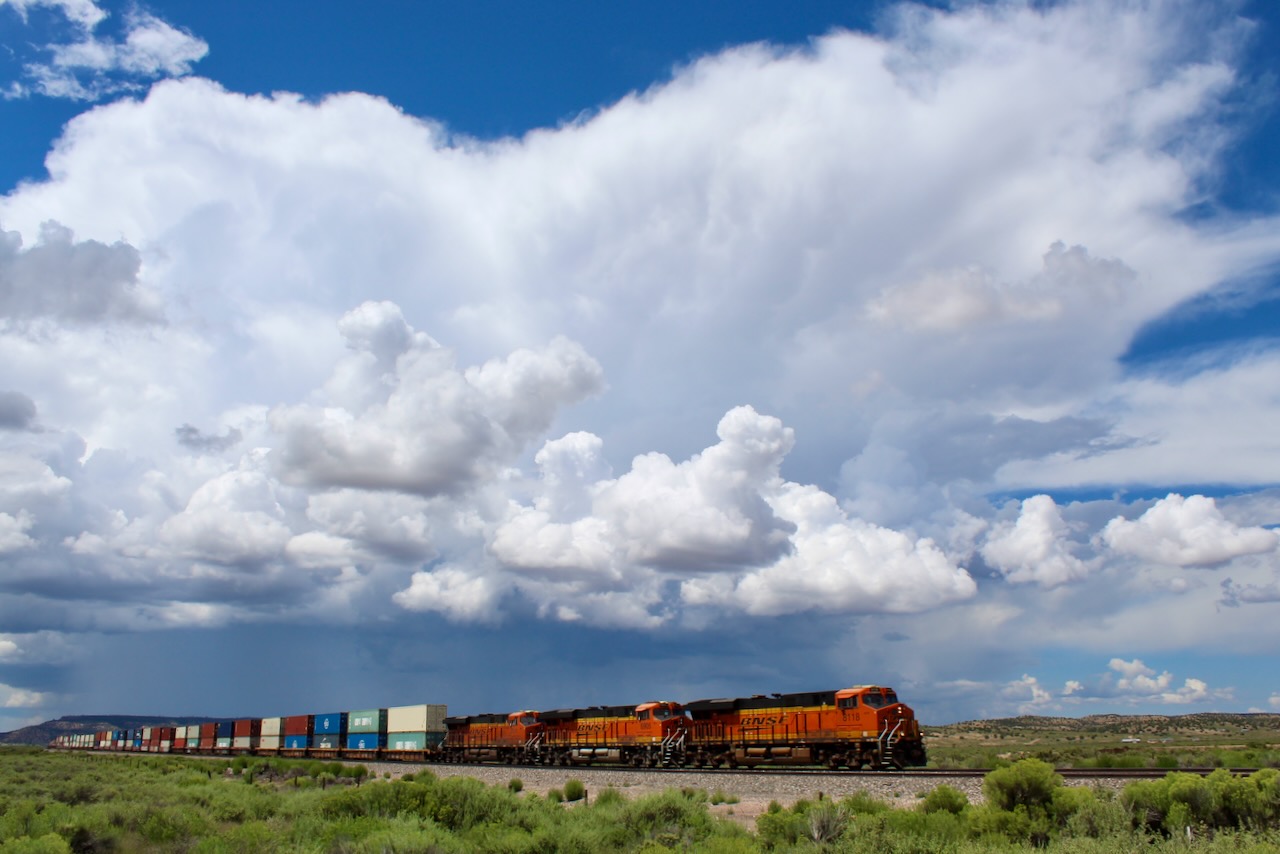
Meanwhile, Mother Nature isn’t doing BNSF any favors. The monsoon season in the Southwest frequently brings the railroad to a temporary halt when high wind warnings and flash flood warnings are hoisted.
The congestion — related to crew shortages, supply chain problems, and bad weather — prompted a fourfold spike in recrews. At its peak in June, more than 20% of BNSF’s trains in California, Arizona, and New Mexico went dead on the federal 12 hours of service law and had to be tied down en route, chewing up more capacity and exacerbating crew shortages.
This is not BNSF’s finest hour. But it’s far from being alone in the doghouse with shippers and regulators. CSX Transportation, Norfolk Southern, and Union Pacific to varying degrees find themselves in the same fix. They’re short of train crews. And if you don’t have all the people you need, a railroad quickly coagulates.
Caught short
When a foreman requests track time on BNSF’s Seligman Subdivision near Flagstaff, Ariz., the dispatcher quickly says he’ll have to wait. “I’ve got seven eastbounds coming at you, and they’re all short-timers,” she explains. Her goal: Make sure the trains arrive at Winslow without running afoul of the hours of service law.
Nowhere has been harder hit by recrews than BNSF in California and across the Southern Transcon in Arizona, New Mexico, and Texas. In this wide swath of territory, the percentage of trains requiring a recrew en route has consistently been the highest in the U.S. since May, according to a review of data reported to the Surface Transportation Board. BNSF’s extra boards in the Southwest are threadbare, leaving the railroad with little cushion to absorb the impact of frequent recrews.
How did BNSF get into such a jam?
The railroad says congestion in Southern California wasn’t a result of any one circumstance, but rather a culmination of multiple factors, including operational constraints, resource levels, and bad weather. Labor leaders say BNSF’s controversial Hi-Viz attendance policy was a factor, too, because it led some veteran crews to leave the railroad. BNSF disputes this and says Hi-Viz has improved crew availability.
Whatever the case, this much is clear: The epicenter of BNSF’s Southwest crew shortage has been Needles, Calif., an old Route 66 town on the Arizona border. As it goes, so goes the 179.6-mile Needles Subdivision to Barstow, the junction of BNSF’s main lines to the Los Angeles Basin and Northern California via the Central Valley.
“Barstow is by design a staging location to meter trains over the Cajon into the Basin and Tehachapi into The Valley, and the Needles Subdivision is a buffer to assist in facilitating optimal meeting times,” spokesman Ben Wilemon explains. “Early on we had a reduction of crews due to attrition. Many businesses in California encountered a similar situation as residents were relocating out of state to less expensive locations. It was difficult to balance employee needs as the volumes were coming in waves and were unpredictable.”
Needles, with a population of less than 5,000 people, is not an easy place to hire. The closest cities to recruit conductors from are Bullhead City, which has a competing job market with nearby casinos, and Lake Havasu City, which is a 45-minute drive to Needles.
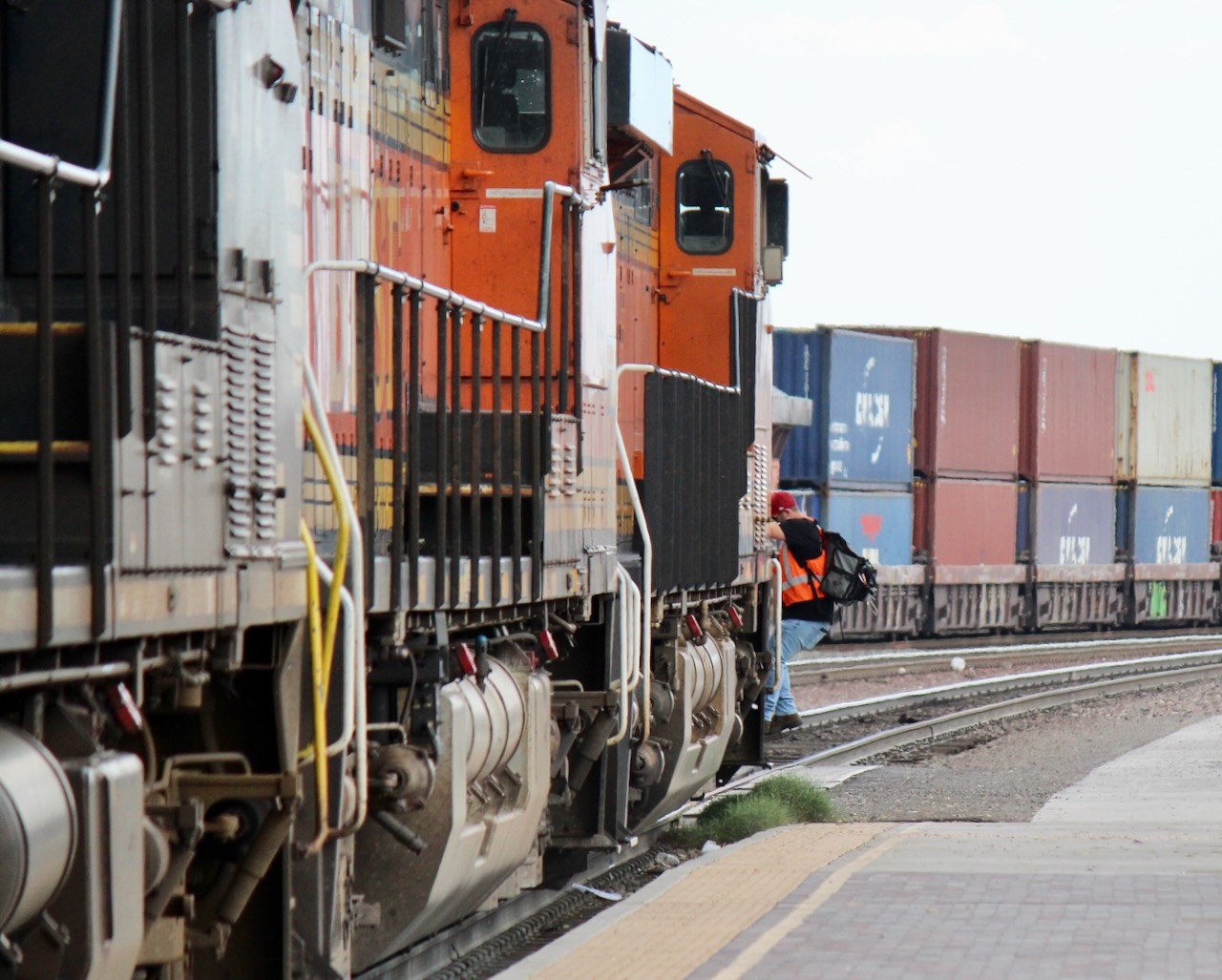
The active crew base at Needles is more than 470 train, yard, and engine employees. As of mid-August, BNSF had filled 34 of the 49 vacant positions, and another 25 people have accepted the railroad’s job offers. BNSF also had 36 crew members transfer temporarily to Needles from other areas on the system.
The new crews can’t pitch in right away. “The new additions to the territory must undergo four months of initial training followed by six months of territory training for familiarization,” Wilemon says.
Imbalanced traffic flows don’t help the crew situation as eastbound trains outnumber westbounds, leaving crews and locomotives out of position, particularly on the Needles Sub.
At the other end of the Southern Transcon, intermodal customers have been slow to pick up their containers at Chicago terminals, particularly Logistics Park Chicago, or LPC, amid high volume and a shortage of chassis, truck drivers, and warehouse capacity.
“Over-ordering earlier this year has left retailers with stagnant merchandise in their stores and crowded warehouse distribution centers with remaining storage space at 1-2%,” Wilemon says. “This has resulted in the usage of boxes on chassis as a storage solution where it’s far cheaper than the cost of storing a container at a marine terminal or rail facility. As a result, chassis cycle times are impacting the availability of those assets to unload trains, and consequently, we are having to meter volume at ports.”
Railroads have had to deal with the slow unloading problem since intermodal traffic rebounded from pandemic declines the second half of 2020. And on BNSF it helps create a downward spiral nearly 2,000 miles away.
“This has led to a significant number of eastbound trains heading for LPC being staged in sidings across the Southern Transcon waiting to arrive at and be unloaded at LPC,” BNSF told the STB. “This phenomenon has, in turn, reduced the velocity of intermodal flatcars due to their inability to be unloaded and the subsequent slowing of their return to the West Coast to handle the continued strong demand for imported cargo. It has also limited our ability to handle other traffic on the Southern Transcon as sidings, mainline segments, and terminals are congested with staged freight.”
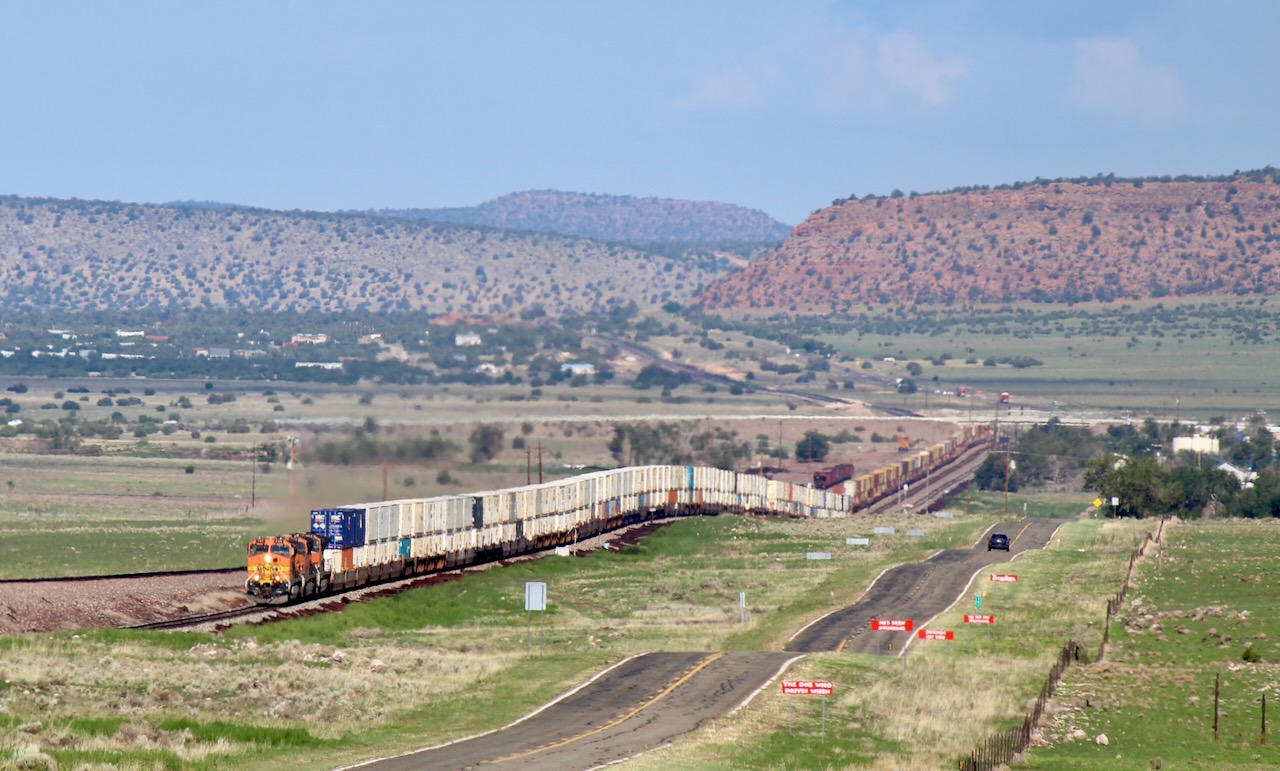
The embargo BNSF placed on some California-bound carload traffic worked: It prevented congestion from worsening over the Fourth of July holiday week, when many crews mark off. And it helped cut in half the number of trains holding for crews.
“The decision to put the limited embargo in place was not one we took lightly,” Chief Marketing Officer Steve Bobb and Chief Operations Officer Matt Igoe wrote in an Aug. 23 letter to customers. “Still, it was a step we knew we had to take in response to significant ongoing service challenges, especially in Southern California. During the past two months, BNSF team members and contractors worked around the clock to reduce the backlogs and ensure that essential commodities flowed. Last week, we were able to grant 89% of permits requested for shipments moving into California. Moving forward, we will continue working collaboratively with individual customers to manage traffic flows and maintain fluidity.”
BNSF told customers it’s making steady progress restoring service, with manifest traffic backlogs at their lowest level since December. Terminal dwell at Barstow, where BNSF classifies traffic to and from the Los Angeles area and northern California, has fallen to 34.8 hours, down from 56 hours when the embargo began. But that’s still elevated. Railroads typically aim for cars to spend no more than 24 hours in a hump yard.
The number of trains requiring a recrew also has improved significantly, falling to 15% in California and to 12% on the Southwest Division, BNSF reported last week. Still, that meant BNSF had to tie down and recrew roughly 20 trains per day in California and 22 trains per day on the Southwest Division. This soaks up crews like a wet sponge, gobbles mainline capacity, and means BNSF can’t handle as much freight as it would like.
Service suffers
For months shippers have faced widespread delays and unpredictable transit times on the big four U.S. railroads, even as service remains at relatively normal levels on Canadian National, Canadian Pacific, and Kansas City Southern.
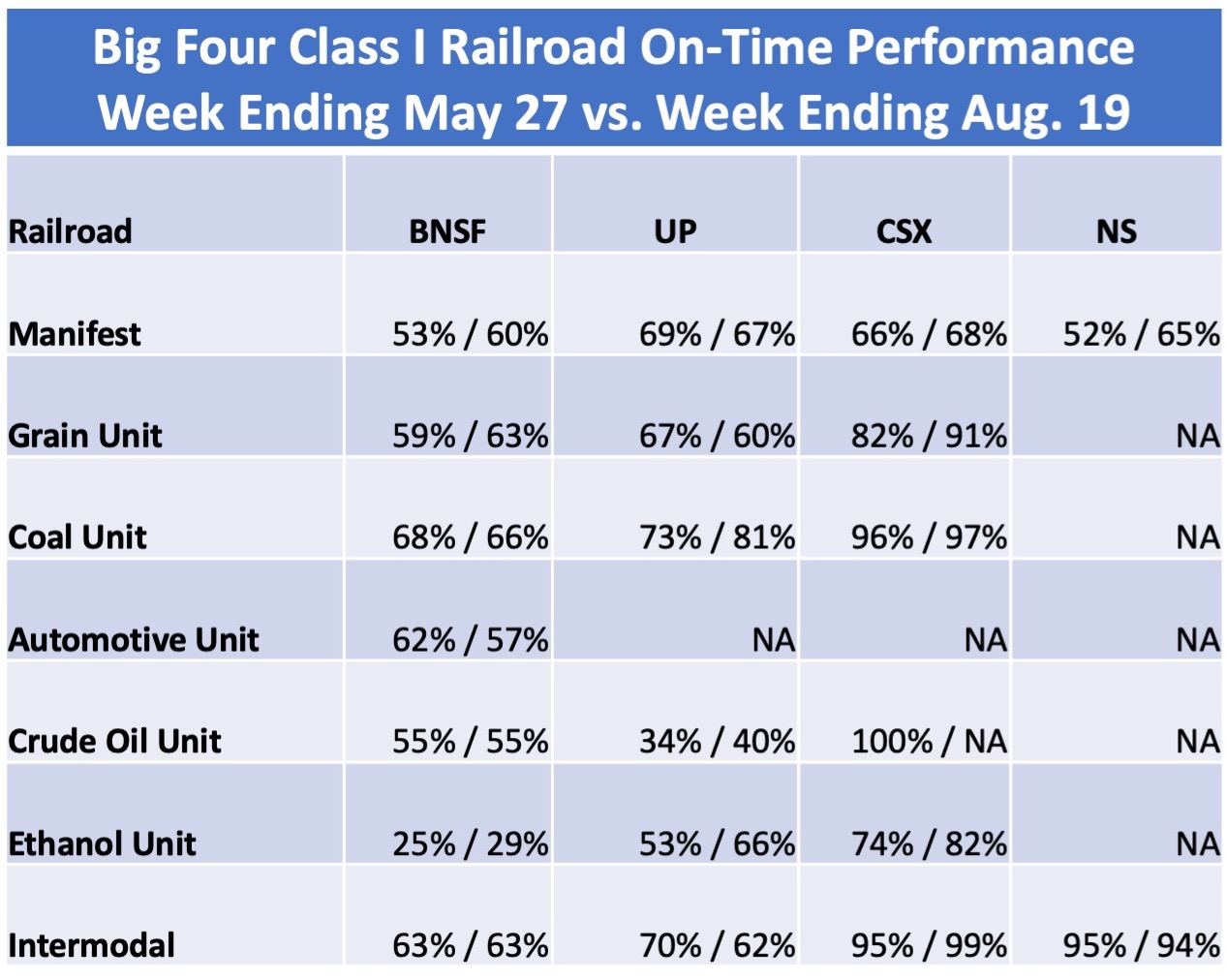
Overall on-time performance for the big four U.S. systems fell from a pre-pandemic average of 85% to just 67% in the last week of May 2022, according to data the railroads reported to the STB.
There hasn’t been much improvement since. Overall on-time performance stood at 72% in the week ending Aug. 19, measured by merchandise, intermodal, and bulk unit trains that arrive at their destinations within 24 hours of when originally promised.
The big four systems’ overall slow and unsteady progress prompted STB Chairman Martin J. Oberman to question whether the railroads would reach their service recovery goals by the end of the year.
Carload shippers say their experience mirrors the on-time performance trends, which ranges from a low of 60% at BNSF to a high of 68% at CSX. Nearly half of chemical shippers said service was worse in July compared to the fourth quarter of 2021, according to a survey by the American Chemistry Council.
Short lines also felt the pain of operational problems at their Class I connections. Says one short line leader: “Class I interchange performance is brutal.”
Even domestic intermodal service is running at historically low levels, with trains routinely arriving a day or two behind schedule, J.B. Hunt executives say. “We never saw numbers like this before the pandemic,” Darren Field, J.B. Hunt’s intermodal president, told an investor conference in August. BNSF is J.B. Hunt’s railroad partner in the west, while NS is its primary carrier in the east.
Executives from another major truckload intermodal customer, Schneider, said its intermodal service was mixed. It was “highly challenged” in the west, where Schneider’s orange containers ride both BNSF and UP, they said on the company’s July 28 earnings call. But they singled out CSX for providing excellent service in the east.
Signs of hope?
In August, BNSF, CSX, NS, and UP executives sounded optimistic. They said their railroads are slowly on the mend as more conductors graduate from training classes. Crew availability is up as summer vacation season winds down. And help has arrived in many critically short locations in the form of conductors and engineers borrowed from other areas.
Some operational data — including average train speed, recrew rates, and trains held for lack of crews — point to green shoots.
Rail executives all said that while they’re encouraged by their railroads’ progress, service is nowhere near where it needs to be. A return to 2019 operational performance, they say, likely won’t come until late this year or early next year.
The railroads say their hiring is on track to meet year-end goals.
Yet the pace of hiring is barely keeping ahead of attrition among train crews, Loop Capital analyst Rick Paterson notes. The lack of a labor agreement, threat of a strike in September, and rank-and-file union members unhappy with the Presidential Emergency Board’s wage recommendations could threaten progress the railroads have made to date.
“For some perspective on attrition, mid-July train and engine (T&E) headcount numbers were recently released and show how challenging this remains,” Paterson said in a note to clients. “BNSF saw T&E headcount fall for the third consecutive month (April 14,679, May 14,578, June 14,505, July 14,440), while the other three major U.S. railroads were able to achieve only modest sequential gains from June to July: UP 13,712 to 13,762, CSX 7,021 to 7,089, and NS 8,058 to 8,080. There’s close to equal pressure from the hiring tailwind versus attrition headwind, and the labor agreement could tip the balance either way.”