

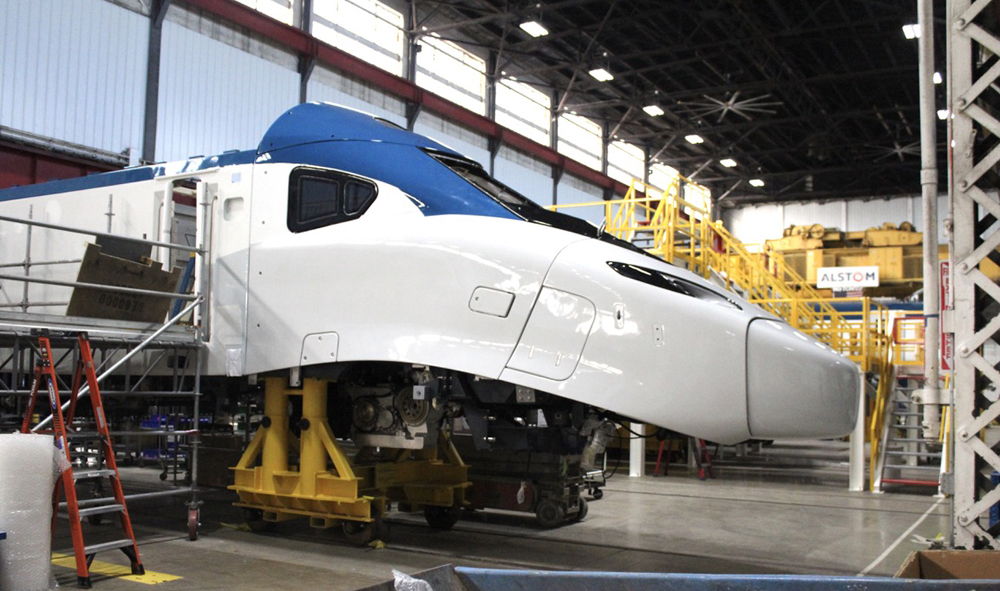
HORNELL, N.Y. — Testing of Amtrak’s next-generation Acela trainsets on the Northeast Corridor has shown that further modifications will be necessary, pushing back the date the equipment will be placed in service because additional testing will be necessary.
Amtrak revealed last week at a Philadelphia media event that the first of the 28 nine-unit trainsets being built by Alstom are not expected to enter revenue service until sometime in 2023 [see “News photos: Amtrak releases images of interiors for new Acelas,” Trains News Wire, April 1, 2022]. The debut originally expected in 2021 had been pushed back last year.
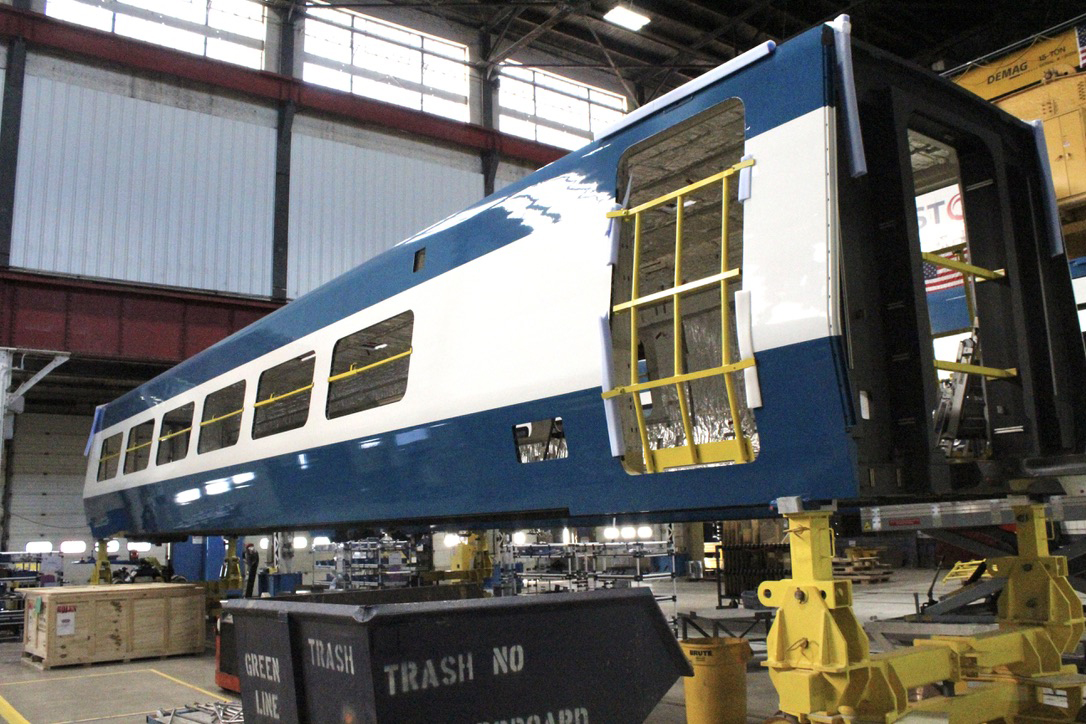
Amtrak says further computer modeling and simulation tests are required, explaining in a statement, “These are the first trainsets built under FRA’s Tier III rule, which sets new design specifications to allow for operation at the highest speeds and on shared corridors. We hope this will be the first of many trains built under this new framework and that the lessons learned here will benefit those efforts.”
The trainsets are 25% lighter than the current Acelas, which were built to earlier standards that required vehicles to not suffer structural degradation in a crash. The Tier III standards allow crush zones to absorb impacts, as long as the passenger compartment is designed to keep occupants safe. This is a standard used by European, Japanese, and Chinese trainset manufacturers to attain higher speeds when operated on dedicated right-of-way with tight track-variation tolerances.
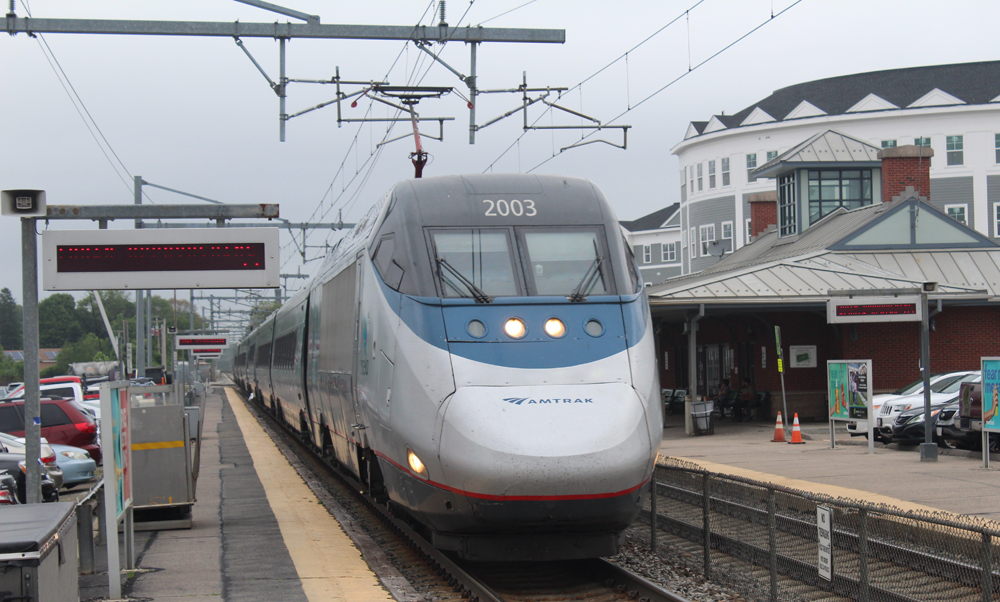
Testing at the Association of American Railroads’ Transportation Technology Center in Pueblo, Colo., saw the train reach and exceed their rated speed of 160, but an integral part of any testing is evaluating performance where they will actually operate. On the Northeast Corridor from Washington, D.C., to Boston, operating conditions vary widely: Original Pennsylvania Railroad right-of-way from the nation’s capital to New York features everything from curving 1873-vintage tunnels under Baltimore to a recently-rejuvenated high-speed straightaway in New Jersey. North and east of New York is ex-New Haven Railroad curving trackage that had been a problem for the original Acelas, but the segment electrified and rebuilt from Connecticut to Boston in the late 1990s is already good for 160-mph operation.
In a statement to News Wire, Alstom says in that in modifications made after testing on the complete NEC route in a variety of conditions, “mass was added to the extremity ends of each car, and additional anti-roll bars were added to the café car to lower the center of gravity over specific wheels and to distribute load on wheels (to optimize) the trainset’s behavior on the curves of the NEC. These changes require updates to the computational model to validate the behavior of the trainsets in parallel to testing activities required by the Federal Railroad Administration (FRA) to enable a smooth introduction into revenue service.”
Asked whether adverse interaction with Amtrak’s ACSES positive train control system or electromagnetic interference was an issue, Alstom says, “The modeling activity encompasses all aspects of track conditions that can be experienced while traversing the NEC in revenue service, and is not specific to the signaling systems used.”
Alstom adds, “Given our 40+ years expertise in designing and manufacturing high speed trains, we do not anticipate any physical alterations. The completion of the modeling and simulation activities are expected to validate the design of the train and ensure the Federal Railroad Administration safety requirements are met.”
UPDATE on April 13, 2:00 p.m. CT: Alstom has clarified to News Wire that “no changes or modifications were made to the trainsets as a result of testing on the Northeast Corridor, and scheduled testing continues on the corridor at the present time.” The company adds that it, “continues to work with the project’s partners (Amtrak and the Federal Railroad Administration), to deliver a safe and reliable product to passengers, and will keep you apprised of the latest developments as we move closer towards that goal.”
Share this article