

Menards first appeared in Classic Toy Trains in 2011 with some custom-run structures by Woodland Scenics. Next were resin structures of a Menards store and a lumberyard/garden center
These were followed by an amazing line of custom-built, assembled, and detailed wood structures. It became clear that O gauge was on the minds of the folks at Menards H.Q., and it was more of a thrill than a surprise when the first Menards freight cars came our way.
In a very compressed window of time, the firm began offering rolling stock, listened to customer feedback, and immediately began to improve the line. Improvements were made to couplers. Couplers and truck frames became metal, and they operated more smoothly. The decoration of the cars (lettering and signage) – while good, became better – to the point that the new large (scale-sized) flatcars have heat-stamped car numbers.
Who is the target?
To paraphrase a line from an old Six Flags amusement park ad campaign, “More trains, more fun!” I think Menards is targeting the audience that wants to run trains – and have as great a variety of rolling stock and road names as possible. Whether the layout is a simple loop around a tree, an elaborate floor layout, or a three-rail octopus filling a basement, we all want our yards and sidings to reveal we have a prosperous railroad. The key to that appearance is freight cars, freight cars, and more freight cars. Freight cars equal traffic, which equals O scale payments to the 1:48 scale stockholders!
But freight cars can add up quickly and be unfriendly to our hobby budgets. I mean, how many people can load up their roster of freight cars at $100 a pop?
Menards offers the perfect solution with a wide assortment of good-looking, smooth-running basic and familiar O gauge freight cars (at this writing, only boxcars and flatcars) at low prices.
Features
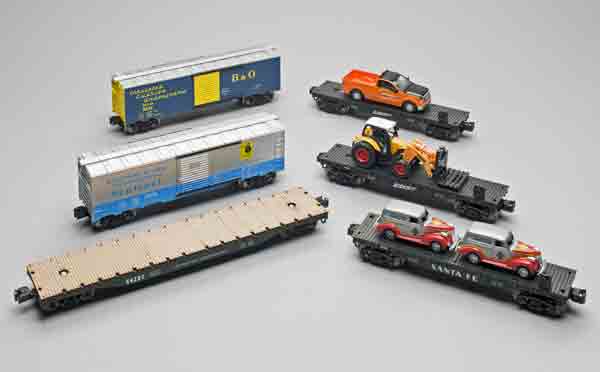
The boxcars: The shell is just a bit more than 10 inches long (40 feet in O scale) and the coupler-to-coupler length is 11¼ inches long. Made of resin, the boxcars have a good level of detail with cast-in rivets and seams and cast-in ladders on the ends. The roofwalk is cast in, but has some nice metal frame texture. The doors open, and the boxcar continues to be a winner in the “play value” category, because it could have just about anything inside. The metal frame has two support beams (folded-over shaped metal) and an add-on air reservoir.
You can buy the boxcars individually for about $20, in eight-car sets, or as a 14-car pack with 14 different road names. Menards also offers several cars weathered at a slightly higher price.
The short flatcar: This car’s frame measures just less than 9½ inches long (38 feet in O scale) and the coupler-to-coupler length is 10½ inches. The resin car has cast-in planking on the deck, and the sides have rivet and seam detailing as well as cast-in grab irons and steps on the corners. A raised support reveals an add-on brake wheel. The beds have slots for stakes to hold cargo in place.
The flatcars are available singly (as low as $7.99 without packaging) or in multi-packs with four to 24 models. Some flatcars come without loads; others have cargo ranging from military loads to panel vans and earthmoving equipment.
The long flatcar: This car wowed me for two reasons: its size relative to the short flatcars and its real wood deck with planks cut into the surface. Where the short flatcars are solid and require no support, the frame of the long flatcar has a grid that supports the wood deck. This struck me as being better than gluing a wood strip on a flat plastic surface. The car comes with stakes to secure a cargo load. This car is available singly or in multi-packs, and is available with a variety of loads such as U.S. Army and U.S. or Canadian Coast Guard helicopters, a space rocket, and construction equipment.
Menards designed the long flatcars to negotiate O-27 curves (O-27 switches may be another thing). You can buy the long flatcars without loads individually or in four packs, and the cars with cargo loads are available singly.
Special cars: Two special “operating” cars are available: a short flatcar with a U.S. Army tank load and a short flatcar with Chicago Fire Department ambulance load. Both vehicles draw power from the track via a power pickup roller.
The tank gun “flashes,” while the emergency lights on the ambulance alternate red or blue. The ambulance is available separately, and the lights operate with battery power (batteries are included). These are clever product ideas.
Painting and decoration
Considering all the Menards rolling stock I’ve seen, I have yet to detect any bad paint anywhere – no overspray onto other colors, no details washed out by paint, and no thin spots. The railroad logos on the boxcars are striking, and if you ever saw them “back-in-the-day,” each will look like a familiar face.
The printing of the assorted reporting marks is all clear and crisp. In case you didn’t notice it in the photos, each car is marked, “Built by Menards 2015” with boxcars also having a small Menards corporate logo. The flatcars, with a smaller canvas upon which to print, just use text.
Speaking of printing, a bonus is that Menards touts the fact that cars have different reporting numbers. Having bought multiples of the same road name, I can confirm this is true. The car numbers are applied to the car like a decal. This must save significant money in the production process yet can still create a unique car.
The number is on a clear film you can see if the light is reflecting just so from one angle; it is invisible from another.
Let me mention the color of the boxcars. The colors of the pieces of rolling stock are satisfactory, but if you’re a stickler, you may find some of the cars have a lighter or darker hue than you remember on the real freight cars.
For example, the New York Central boxcars are a darker green than the traditional jade green; however, that didn’t stop me from buying four of them. For me, the desire for the car, the road name, the cigar-band graphics, and the low price outweighed a variance in the color. I recently bought a New York Central boxcar for $70 and I expected close to perfection on it. But I will happily run the Menards cars with the big buck cars and be pleased with all of them.
The variety of the new Menards line of freights cars is impressive, as is its strategy of announcing new products steadily throughout the year – no wonder I look forward to the weekly email from Menards. The product line has improved over its short lifespan, and I have been pleased with all the Menards rolling stock I have.
The models are well made, have nice graphics, and permit an O gauger to build a railroad empire on a brakeman’s budget.