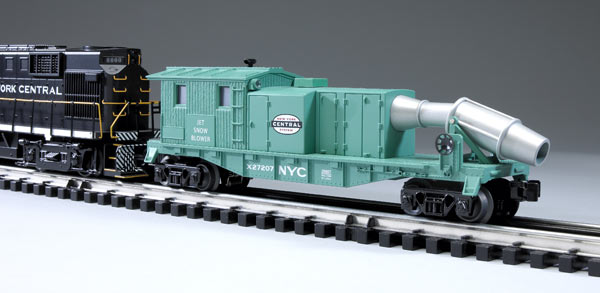
One of the most interesting methods of clearing snow quickly was tested by the New York Central in the 1960s. These snow blowers used superheated high-speed air generated by a jet engine to blast away ice and snow from track and especially from the workings of switch machines.
The jet engine of choice was the General Electric J47. This engine, which was used with some success during the New York Central’s famed M-497 jet-powered Rail Diesel Car experiments, weighed 2,700 pounds, generated 5,670 pounds of thrust, and, when attached to the right aircraft, could speed as high as 670 miles per hour.
From 1963 to 1967, the New York Central cobbled together at least three jet snow blowers, each seeming to be a unique design featuring a jet engine and a control cab.
Opening the box
Lionel offers three road names for the O gauge snow blower – Alaska RR, New York Central, and Pennsylvania RR – as well as a generic maintenance-of-way paint scheme.
Our Lionel model appears to be based on the New York Central’s no. X27208, which was built upon the chassis of caboose no. 18002. Lionel’s car carries the NYC no. X27207. On the prototype, the jet engine and its housing are mounted on the forward part of the car, while the control cab is at the rear, the original caboose cupola giving the operator a good view.
Lionel’s O gauge model copies the first part fairly well, but it uses a transfer caboose cabin, which has a top that’s pretty even with the engine housing. It doesn’t provide much of a useful view for the crew.
There are what appear to be two spotlights on the front of the cabin, facing out over the jet. These do not illuminate; neither does the cabin interior.
The smoke unit fill point is hidden beneath an exhaust screen in the middle of the roof of the jet housing.
When activated, the smoke travels out the long forward duct. The nozzle on the end of the car does have some flex, so you have a little variety as to the angle you can position it.
Apply power, and the fun starts to happen. Well, if nothing happens other than the smoke unit operating, cut power and start it again. The jet sound should spool up simultaneously.
The jet engine sound emulates a big aircraft turbine – two thumbs up in that regard.
Once the juice flows, the fan-driven smoke unit does pump out the white stuff, and it looks pretty spiffy as the car is being pushed around the pike. After I’d been running it on the test track for a bit, one of the staffers from a Kalmbach jewelry title stuck her head in the workshop. She seemed particularly impressed with the volume of smoke.
“Is it safe?” she asked, pointing up at the overhead fire-sprinkler system.
“We can only hope so,” I said.
Operation of the snow blower was great, and it’s the sort of car that will still catch the eye when it is parked in a backshop yard during the summer months. You just don’t see anything like this today (although there are jet snow blowers in use), and it is a pretty cool addition to the fleet.
Price: $119.99 (no. 29867)
Features: O-27 operation, jet sound effect, smoke unit