

YOU CAN STILL SEE THE TRACES HERE AND THERE. A section of back road with the unmistakable appearance of a tree line and a long-gone grade crossing; perhaps a concrete overpass converted into a bike trail years ago; or maybe an old industrial building that looks like it had a siding for freight deliveries, but the tracks are just a memory.
The remnants of an abandoned freight railroad, perhaps?
Nope, I’m talking about the traces of an interurban electric railway. Interurban lines once formed a net over much of America. Old railroad atlases identified them as “Interurban Railways,” and regular railroads were dubbed “Steam Railroads.” The steam railroads were usually a dark line on the map, while interurbans were either a thin line or a thin dashed line. Cool, huh?
Most interurban lines were early victims of either the Great Depression or America’s love affair with the auto, but a few hung around a wee bit longer.
One line that lived beyond the 1940s was the Chicago, North Shore & Milwaukee RR, a high-speed electric freight and passenger line between Chicago and Milwaukee, with branches running to Mundelein and Waukegan Ill., and a loop of a line from North Chicago to Evanston, Ill. and back up the shoreline to North Chicago.
The North Shore was part of a network of three electric railways offering both freight and passenger service that served the Chicago area: The Chicago South Shore & South Bend (which continues to operate), the Chicago, Aurora & Elgin (passenger service abandoned in 1959), and the North Shore, itself abandoned in 1963.
While I’ve often admired these K-Line sets, I’ve never plunked down my cash until now – an interurban road name with a tie to an area where I’ve lived – in this case the Milwaukee metropolitan area.
What’s in the box
K-Line has been fielding interurban sets since 1991. These were simply slightly modified and motorized passenger cars with add-on details and different end pieces (with square or round windows for the motorman). Versions have included models with straight trolley poles and regular pantographs. Some have had porthole engineer windows, while others have had square engineer’s windows.
At least through the late 1990s, silhouette inserts have been used instead, with later models featuring interior decoration and crew figures.
Past K-Line interurban road names have included the South Shore, the Pennsylvania, the Reading, and the Pacific Electric Ry.
Quite simply, what we have here are some neatly duded-up coaches. The cars in this set are 15 inches in length. One is powered and the other is a dummy trailer. Both come with two trolley poles apiece (these come bagged and are easily installed).
Both cars have powered truck frames, but only one car is actually motorized (and those wheels are equipped with traction tires). The lead trucks on both cars have steam-style “cow catchers” on the pilot.
The cars are well-built with a satisfactory level of cast-in detail, mainly in the rivet department. The end doors are all cast-in, and the side doors seem to be add-on pieces, but they don’t open.
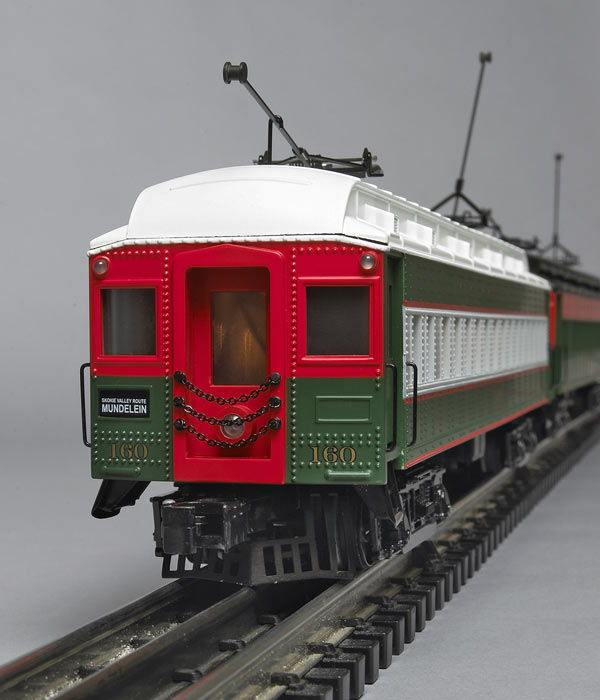
Add-on details are a bit slim, because the prototype lacked an abundance to copy on the model. On the “lead” front doorway, you’ll find safety chains across the gap and a headlight mounted in the door. Wire grab irons can be found at each of the corner doors, and plastic steps are mounted to the trucks.
Frosted plastic hides the motor in the powered unit as well as the ends of the cars (alas, no crew figures). The interiors feature seats, passengers, and lighting. These are nicely done.
I was a bit surprised to find no engineer/motorman, but there are enough passenger figures to keep the line in the black for a while.
Graphics are very good. One car is in a North Shore paint scheme, while the other appears to be in the colors of the Chicago, Aurora & Elgin but with North Shore lettering. Both have a North Shore logo affixed to the side. The powered unit has the destination “Skokie Valley Route Mundelein” prominently featured and the trailer has “Milwaukee” as its destination.
On the test track
The rig offered pretty decent operating characteristics. Our low-speed average was 15.1 scale miles per hour while our high-speed average was 80 scale miles per hour. Drawbar pull was 1 pound, 3 ounces.
Each car has two power pickups about 6½ inches apart. The cars have directional lighting, and this is controlled via a tether that connects the two cars.
The powered and trailer units each have two pickup rollers roughly 6½ inches apart. The powered unit houses the sound system, while the directional lighting is controlled with a tether (originating in the trailer).
I tried running the powered unit without the trailer, and for some reason, the slowest speeds were exceptionally high (as in the bad old days of K-Line trains that started in the 40 to 50 scale mph range) and movement was very jerky on the slow-speed side. The sound system operated continuously with random horn and voice routines (and even a spurious bell activation).
But fear not, I coupled and mated the powered unit and trailer, and the low speed got lower (possibly due to the additional power draw). Operation was smooth, and the sound system operated normally.
The car features a bare-bones sound package called Passenger TrainFX. This simulates electric motor sounds, horn, bell, and dialogue. This was okay. The electric motor sounded – like an electric motor. The station sounds were appropriately fuzzy-sounding (like they were coming through a PA system) and the horn and bell were good.
Was I happy with my purchase? You bet. Performance was nice, the model evoked the sight of an interurban, and the set was colorful.
Price: 229.99 (no. 22287-1)
Features: Two can-style motors, interior decoration and illumination, directional lighting, passenger sound effects
Staff comments: Interesting, value-priced model; run as a pair, don’t try to single-unit-it. – Bob; I would have preferred matched paint schemes, but it’s still an appealing little train. – Carl