

Of the gazillions of prototypes out there, Lionel settled on the USRA 0-8-0 steam locomotive. That venerable steamer wasn’t used for high-speed freight or passenger service, but was intended for lugging heavy freight around a yard or industrial plant. While it lacks the flair of a high-stepping mainline steamer, the 0-8-0 has a down-and-dirty appeal all its own. I don’t know what Lionel’s leaders were thinking, but their choice works for me.
Many times we’ve discussed USRA locomotive designs – created for World War I, but largely undelivered before the armistice was signed in 1918. Many of the designs were so good that they – or derivative custom designs – soldiered on to the end of American steam.
Opening the box
Surprise! I didn’t open the box – it was already opened for me. I bought our 0-8-0 as a breakup item from a no. 30089 Pennsylvania Flyer freight set ($199.99 retail) offered by a local retailer. He was a bit down on the model (he seemed to think there would be too many “break-off” points for a youngster), but since I’m a grown-up, I figured I’d take a chance with my clumsy fingers and add it to my fleet.
For the past decade or so, the steam power on the point of a Lionel starter set has generally been a 4-4-2 Atlantic. That model has always impressed me as a rugged representation of a steamer (rather than a clear model of a specific prototype), but the 0-8-0 is a nice step up from that basic locomotive.
The tooling produces a great shell – the detail is pretty good. Many details are what you’d find on a higher-priced model, but instead of being add-on parts they’re cast in.
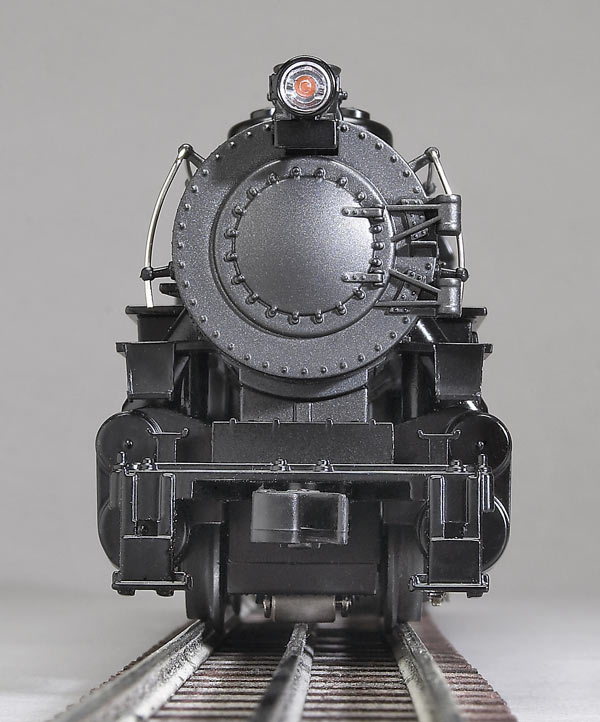
The pilot has a wide gap for the front coupler. You’ll find steps and a cast-in uncoupler arm. More steps rise off the pilot to allow a “step-up” to the running boards on both sides of the boiler. The smokebox face has plenty of cast-in rivet and hinge detail, and a headlight is placed atop the front.
The top half of the boiler is die-cast metal, and has cast-in boiler bands, pipes, conduits, sand lines, and even steps. The top of the boiler has a steam dome as well as two sand domes (remember – it is a switcher and needs lots of sand for low-speed startups). I was surprised and pleased to see a cast-in diamond-shaped builder’s plate symbolizing construction by the Lima Locomotive Works.
Handrails run up from just behind the smokebox face and along the length of the boiler. You’ll also find an add-on bell, turbine, whistle, and two pop-off valves.
The bottom half of the boiler (below the running boards) is plastic and runs under the boiler, completing the shell for the appearance of a real boiler, rather than a mostly round tube with a big hole for a motor and electronics. There is also a large gap between the boiler and frame, which to my surprise looks pretty prototypical according to some of the photos I’ve checked. This “under shell” has a satisfactory level of cast-in detail for rivets and piping.
The cab is nicely done, with a smart level of cast-in detail on the backhead. Amazingly, this detail extends all the way to the top of the cab roof – you’ll need to flip the engine on its back and look up into the roof area to see what I mean. Cool!
There are also two crew figures positioned by the windows. There is no glass in the windows, and the window frames are solid outlines.
The wheels are solid, but represent a spoked type. Oddly, the locomotive mounts only one traction tire (on the engineer-side rear wheel). The running gear is ultra-simple, and not in a good way. Lionel’s separate-sale (and higher-priced) set locomotives have more elaborate running gear. I’m kicking around the idea of running down to Wally World and picking up some gun bluing. Maybe if the gear were subdued, it won’t look so … uh … cheap.
The tender is a good replication of a typical USRA tender. It’s unique among most starter-set steamers because of its very high coal bunker. The shell possesses an adequate level of detail, including a cast-in coal load, rivet detail, and cast-in grab irons. There are three solid water hatches on the deck and a solid rear light.
You’ll find an add-on ladder mounted on the rear, and the tender sports an operating thumbtack coupler.
Paint and decoration are good, especially noting that the locomotive has a two-tone (black with gray accents) paint job on the boiler. The limited amount of lettering was crisply applied.
On the test track
The 0-8-0 generally met my expectations for starter-set power. The speed range was okay, and the drawbar pull was a bit light (but the prototype was a switcher and not a heavy road engine).
My only wince came when I noticed something of a lurch in the steamer’s operation in the middle-to-lower speed ranges. This wasn’t something that would ruin the operating experience – just something you don’t see much of when running power with the latest speed-control systems. But then this engine cost me way less than $100, so let’s keep it in perspective.
Operation was on par for a conventional starter-set locomotive. Our low-speed average was 11 scale miles per hour, and the high-speed average was 61.2 scale miles per hour. Drawbar pull was fairly light – 5 ounces – which probably equates to eight to 10 modern, free-rolling cars on a flat surface.
Comparing this 0-8-0 to the no. 18644 starter-set 4-4-2 I tested for the March 1999 Classic Toy Trains, I find it to be slower on both the low- and high-speed sides – which isn’t bad. However, this steamer has more limited drawbar pull (possibly because it mounts only one traction tire).
The 0-8-0 has two power pickup rollers that are spaced 3 inches apart. The tender is independent of the locomotive and has a single truck-mounted power pickup roller for the whistle.
The air whistle was fine. The smoke unit didn’t live up to the torrents coming out of the stack as shown in the catalog, but it did deliver nice puffs of smoke when chugging along.
So I’ll rate my bargain-basement buy as satisfactory. Even if I’d had to buy the whole set (I didn’t need the rolling stock, track, or power supply), I think I’d still have been ahead of the game. So I’d say, come on in, the water in the shallow end of the hobby is fine.
Price: $199.99 (complete set no. 30089), $119.99 (separate-sale no. 38651 Lionel Lines 0-8-0)
Features: Can-style motor, top half of boiler is die-cast metal, headlight, smoke unit, air whistle, plastic trucks and couplers
Staff comments: Decent rendering of a USRA locomotive and not bad for the price; plastic couplers are a bit low-bidder, though. – Bob