

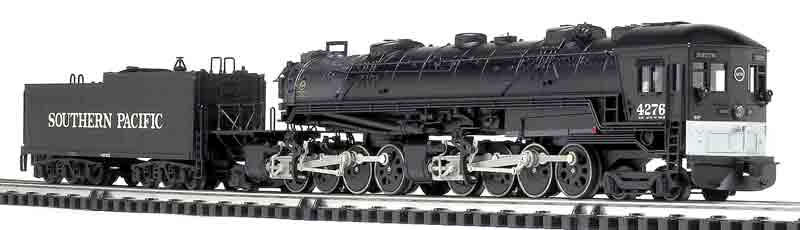
Though the Southern Pacific adopted the Cab-Forward design to ensure its crews didn’t suffocate in long tunnels and snow sheds in the Sierra Nevada mountains, I reasoned that surely the enhanced visibility of the design showed the way to the future.
Between 1909 and the end of steam operation, the Southern Pacific rostered more than 200 Cab-Forwards in a variety of wheel arrangements. These were classes MM, MC, and AC-4 through -12.
Although the Cab-Forwards could be seen in deserts and forests, they are most associated with heavy trains and mountain tonnage.
In spite of their sterling performance and ironclad association with the Southern Pacific, just one survives today. AC-12 class Cab-Forward 4-8-8-2 no. 4294 is on display at the California State Railroad Museum.
Don’t miss a video of the Lionel Cab-Forward running on one of our test tracks.
Opening the box
This Cab-Forward is part of Lionel’s LionMaster product line of semi-scale yet highly detailed locomotives that are designed for layouts with O-31 curves.
Priced at $849, the AC-12 is not an economy model although it’s marketed as a more affordable alternative to top-of-the-line trains. Reduced in dimensions for the O-31 operating crowd, the AC-12 is made well, possesses heft, and contains quite a bit of scale-level detail.
The LionMaster AC-12 frame measures 111 feet long in O scale (27¾ inches). The prototype’s length is 128 feet, so the locomotive and tender combined are just over 4 inches short of a 1:48 scale model. The model is also not as tall or as wide as a scale model.
The model’s tooling is superb, with a high level of both cast-in and add-on detail. The add-on detail pieces are both easy to spot and durable – my big fingers didn’t snap off a single piece of detail.
From an operator’s perspective, the only downside is that some scale-sized rolling stock may look too large for the model. So if size matters, you may need to choreograph the mix of rolling stock in your freight trains.
On the test track
Drawbar pull for the weighty 11-pound 13-ounce locomotive was 3 pounds 2 ounces. Basically, this steamer will pull anything you throw at it, but be sure your bridges are up to the task.
Our low-speed test average was 4.3 scale mph and our high-speed average was 76.7 scale mph. The model’s two can-style motors quietly power the twin drive-wheel sets, resulting in the sound of gears in perfect harmony. Both wheel sets pivot for maximum flexibility.
Underneath, the locomotive has two power pickups roughly 6½ inches apart, and the tender has two more mounted 4¾ inches apart.
The sound system is utterly outstanding, producing sounds that are deep and rich. The thunks, clunks, and the cycling of on-board compressors, combined with the in-and-out-of-sync sounds of two sets of drivers, are among the best I’ve heard.
The tender has four opening water hatches. Two of them cleverly hide controls for volume, RailSounds/SignalSounds, and run/program. Smoke unit and speed controls are under the cab.
In operation, the only weak spot on our sample seemed to be the smoke unit. I could smell the smoke fluid, but for the most part, I couldn’t actually see the smoke (in either conventional or command-control modes).
The AC-12 Cab-Forward isn’t an economy model, nor is it scale dimensioned, but it is a great way to add something quite special to your roster.
Price: $849.99 (no. 11107)
Features: O-31 operation, die-cast metal construction, TrainMaster, RailSounds, and Odyssey systems, two can-style motors
Pros: Beautiful detail; smooth, clock-like operation; impressive sound system, great for tight-diameter curves
Cons: Price, weak smoke output
Made in the People’s Republic of China for Lionel LLC