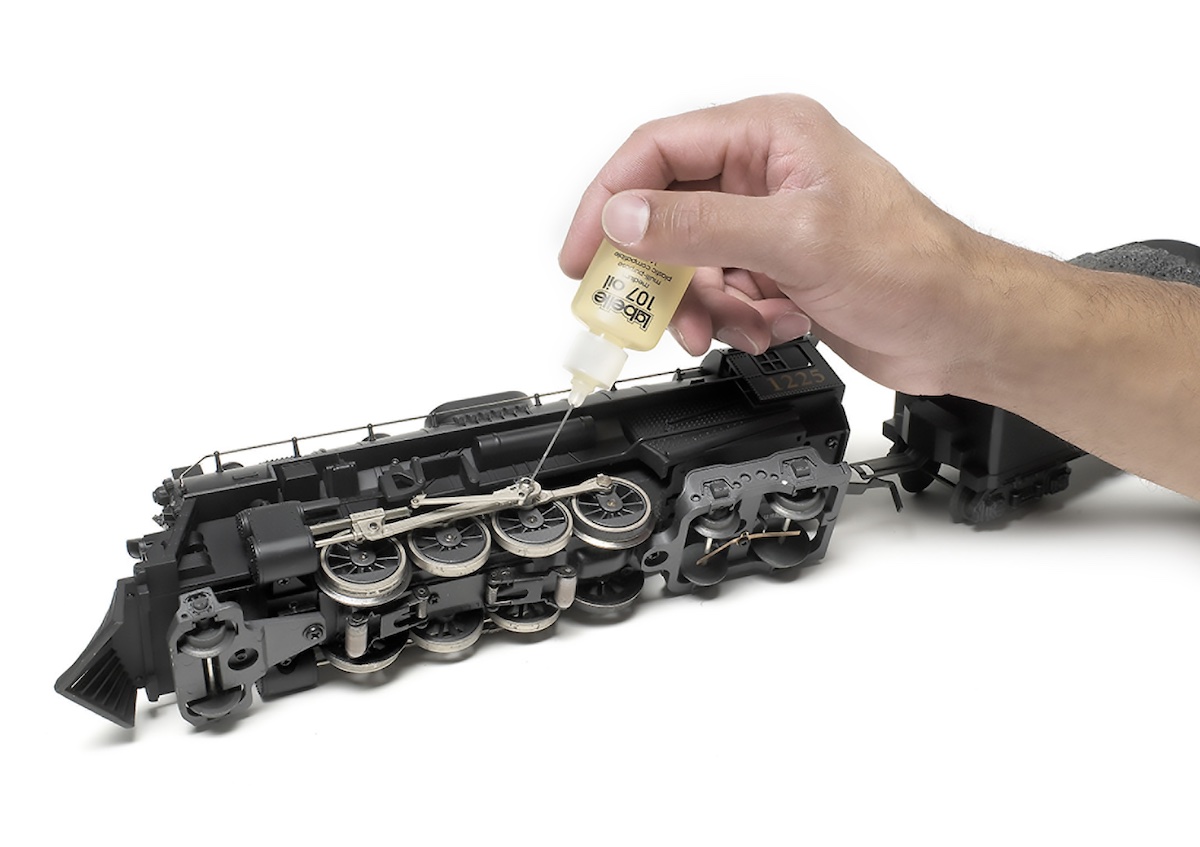


Get your old trains running again! It’s time to take them out of the boxes and have some fun. In this chapter from Beginner’s Guide to Repairing Lionel Trains, Ray L. Plummer offers advice on how to do it.
Get your old trains running again

“Old electric train” – that’s what it says on the cardboard box. Can all of it be in there? It seems so much smaller than you remember. The anticipation in the air jacks up the atmospheric pressure by at least three millibars.
Perhaps the excitement stems from having the corrugated carton in which the train was originally shipped: from Lionel at Irvington, American Flyer at New Haven, Marx at Girard, or Ives at Bridgeport. After all, boxed sets are highly prized today.
Even if you’re not that fortunate, and your newly discovered treasure chest once contained canned beans or laundry detergent, it doesn’t matter. The thrills triggered by the presence of the train are the same – like Christmas and your birthday wrapped up together.
Find out what your Lionel and American Flyer trains are worth.
Take them out of the box
Open the box carefully. Take a running inventory as you unpack. Although train sets varied widely in their components and consists, certain essentials were common to all of them:
- Obviously, there should be a locomotive – usually of steam, diesel, or electric profile. There should also be some freight or passenger cars for it to pull – three or four of these in most instances.
- Enough sections of track to form a small layout came with the basic train. Most people bought additional pieces for expansion. Whether your set is 0 or 027 gauge, you’ll need at least eight curved track sections to assemble a circle in order to test-run your train.
- There must also be a transformer, a little box (usually black) to be connected between the electrical outlet on the wall and the track. Its function is to reduce the 120-volt house current to a safer level – somewhere between 5 and 20 volts – so the trains can be handled without the danger of a severe electric shock. The transformer regulates the speed of the train, controls its direction, and activates the whistle or horn on models that are so equipped.
- You will also need a connector, commonly known as a “lockon.” This little device snaps onto the track and holds the lead wires from the transformer in place. Two short pieces of wire are required between the transformer and the lockon. Look for them in the bottom of the box.
What you need to get going
There usually is at least one baffling item in every box of trains. My best advice is to disregard it. If the item is important (maybe it’s a missing part), that will become apparent as you go along. Chances are, this oddball piece was lying near the track when someone last put away the train.
Now that you’ve unpacked the box and taken a quick inventory of its contents, you should conduct a visual inspection of the individual items. Examine each piece carefully, inside and out, to determine whether there are any bent, broken, loose, or missing parts that might get in the way of a mechanical function on the toy railroad. Although unsightly, damaged external trim parts may be ignored for now. Check for signs of deterioration that may have occurred during storage.
Rust is the biggest problem with trains that have been packed away in damp basements. It is readily apparent on the exposed metal surfaces, such as car wheels and track. Visible external rust usually indicates the likelihood of internal rust as well. It may be inside the locomotive mechanism or the transformer case. Finding heavy rust on anything in the train box should be taken as a sign of potentially serious trouble.
Fixing issues
Of course, trains stored in hot attics can have their own set of problems. For example, many plastic parts, even entire car bodies, tend to warp and disfigure when they get too hot. This condition is usually quite obvious. Repeated overheating while in storage can also cause the insulation around wires to dry out, crack, and break.
How to clean up your old passenger cars.
When this happens to a locomotive or operating car, it can be very annoying. However, when the line cord and plug of a transformer are involved, it can be downright dangerous. Therefore, check all exposed wires for cracks and bare spots. Wiggle and bend each one to be sure that the insulation is still intact and supple. You really can’t be too careful here.
Next, spin the locomotive wheels by hand to see that they turn freely without binding. Check to see whether anything inside the mechanism has become loose or stuck; it could cause a short circuit or other trouble when you apply track power. Spin the car wheels, too, and inspect them for binding and scraping or bent axles.
This is also a good time to do some preliminary cleaning of the exterior surfaces of the locomotive and cars. Use a clean, dry paintbrush to remove superficial dirt and dust. This gets into all the cracks and corners very well. If the trains still appear dingy, gently applying a little Pledge or another mild furniture polish on a soft cloth usually works wonders. Light rubbing is the key.
Some people prefer to use a petroleum-based preparation, such as WD-40 or CRC 5-56. You’ll find that basically it’s a matter of personal taste and choice. Heavier cleaning jobs require different products.