

WASHINGTON — Intermodal volume continued to be an issue for U.S. railroads in September, as container and trailer movement was down 6.7% over September 2020, leading to an overall traffic decline of 1.9% for the month despite a 4.3% increase in carload traffic.
“Rail intermodal volume is clearly not what it has been and could be,” Senior Vice President John T. Gray said in the Association of American Railroad’s summary of the month’s traffic. “Keeping intermodal terminals functioning smoothly and at full capacity depends on consistent freight outflows to make room for new freight inflows. Unfortunately, due to limited availability of downstream truck and warehouse capacity, that’s not happening right now with predictable impacts on rail intermodal volume. There is no single solution to this problem but railroads are bringing intermodal yard capacity back online to increase storage availability as well as working with customers and truckers to accelerate container pickup among other efforts.”
Carload traffic included a 13.7% increase in coal and a 12.5% increase in crushed stone, stand, and gravel; motor vehicles and parts were down 27.6%, reflecting manufacturing issues resulting from continuing computer-chip shortages.
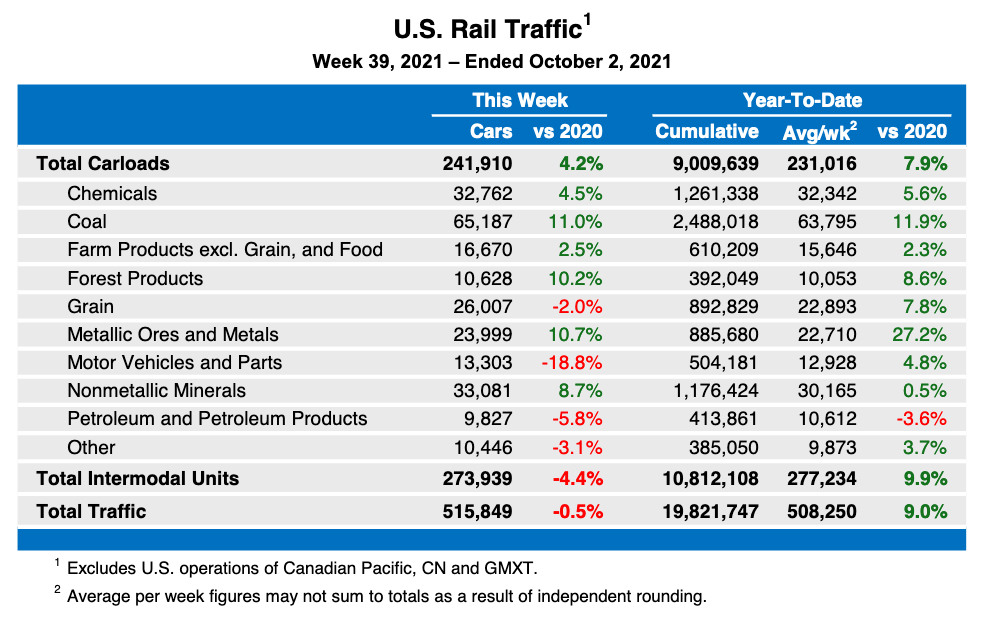
Year-to-date traffic remains well ahead of 2020 volume, with carloads up 7.9% and intermodal units up by 9.9% for a total increase of 9% through the first nine months of 2021.
Weekly traffic also shows intermodal drop
U.S. traffic for the week ending Oct. 2 totaled 515,849 carloads and intermodal units, a 0.5% drop compared to the corresponding week in 2020. That included 241,910 carloads, up 4.2%, and 273,939 intermodal units, down 4.4%.
North American totals for the week on 12 reporting U.S., Canadian, and Mexican railroads, include 340,442 carloads, up 2.9%, and 356,688 intermodal units, down 6.3%. The total volume of 697,130 carloads and intermodal units represented a 2% decline over the same week in 2020.
Share this article