

WASHINGTON — When President Joseph Biden touted the possibility of 1½ -hour trips between Washington, D.C., and New York in his April 30th address in Philadelphia for Amtrak’s 50th anniversary, he said elimination of three curves could potentially make that possible.
That prompted Trains News Wire to follow up with Amtrak on the current engineering and funding status of important Northeast Corridor infrastructure upgrade projects — and to check what is possible in terms of corridor travel times.
Biden was invited to ride Amtrak locomotive cabs a number of times on his thousands of treks to and from Washington, according to observers familiar with his travels [see “Joe Biden’s Amtrak connection,” News Wire, Sept. 25, 2020]. One of the slow zones he cited to an NBC-TV reporter and photographer during his years as a U.S. Senator from Delaware was the reverse curve at Elizabeth, N.J.
Amtrak says current speed limits on the two center tracks of the four tracks at Elizabeth — the two typically utilized by intercity trains — is 80 MPH for Acela and 70 MPH for Northeast Regionals.
“Passengers may notice trains operating slightly slower than that,” spokeswoman Beth Toll tells Trains News Wire. “This is due to a restrictive ‘approach limited’ signaling that governs the approach to Elizabeth, requiring trains to make a braking application.”
Amtrak’s version of positive train control, the Advanced Civil Speed Enforcement System, allows approaches to curves to have more tailored braking patterns, but the signal indication itself governs the speed here. Toll says this operating practice is being revisited so that trains like the new Acela can operate under ACSES’ enhanced features at maximum authorized speeds around curves.
Many other areas on today’s Washington-Boston route have speeds limited by existing infrastructure and track patterns. These include:
— The B&P Tunnel, actually three tunnels dating from 1873 under the streets of Baltimore, limiting trains to 30 mph;
— The complicated Zoo Interlocking junction with the Harrisburg-Philadelphia Keystone corridor, north of Philadelphia’s 30th Street Station;
— Approaches and tunnels under the Hudson and East rivers at New York;
— Harold Interlocking in Queens, the busiest rail junction in the U.S., where the Northeast Corridor meets the Long Island Rail Road’s main line and Port Washington Branch;
— The climb to the Hell Gate Bridge, the arch bridge that rises of 135 feet over the East River;
— 56 miles of 80-mph running on Metro North between New Rochelle, N.Y., and New Haven, Conn., and limits on drawbridges more than 100 years old;
— A twisting route along rural Connecticut’s shore;
— Curves through New London, Conn., and across the Thames River drawbridge;
— Restrictions caused by curves at the Mystic, Conn., and Providence, R.I., stations.
Straightening the right-of-way to eliminate these slow sections would require significant funding and require engineering studies that haven’t begun. Two long-overdue projects referenced on the above list are under way, but have a long lead time. For instance, engineering is in the final design stage to replace the B&P tunnels south of the Baltimore station by constructing new tunnels on a new route.
Amtrak’s Toll says, “Early construction activities, such as [structure] demolition, utility relocation, and bridge work are anticipated to be initiated in 2022 and 2023. Funding for tunnel construction has not yet been secured, but Amtrak’s legislative requests include funding to support construction activities. Pending sufficient funding being secured, the new tunnels are targeted for completion in 10 to 12 years.”
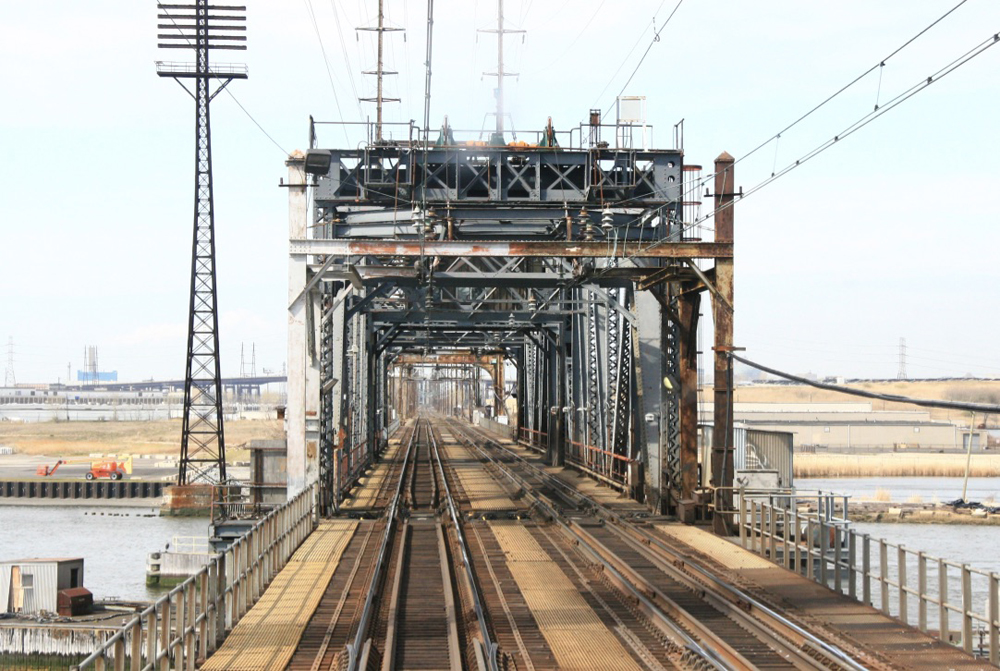
On the New Jersey approach to New York, the $1.8 billion North Portal Bridge replacement is now in the procurement phase “with the hope that a [construction] contract can be awarded by the end of calendar 2021,” says Toll. NJ Transit secured a Federal Transit Administration commitment for more than $765 million earlier this year and Amtrak will be kicking in up to $350 million. Once begun, the new bridge construction and track reconfiguration will take about five years. When finished, maximum authorized speeds will increase from 60 to 90 mph, with capacity expanded, maintenance streamlined, and reliability improved.
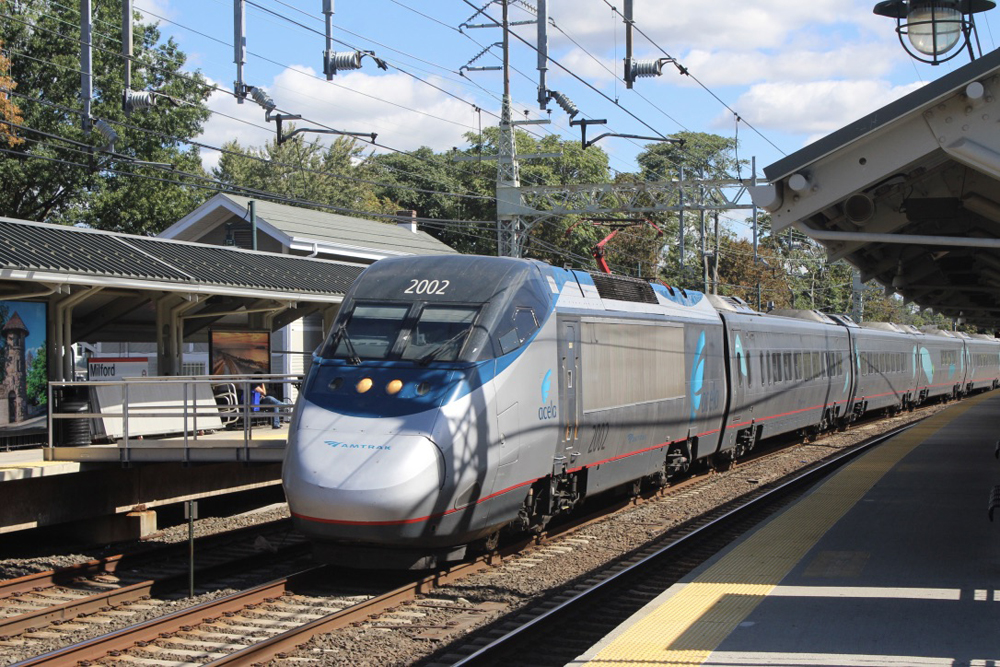
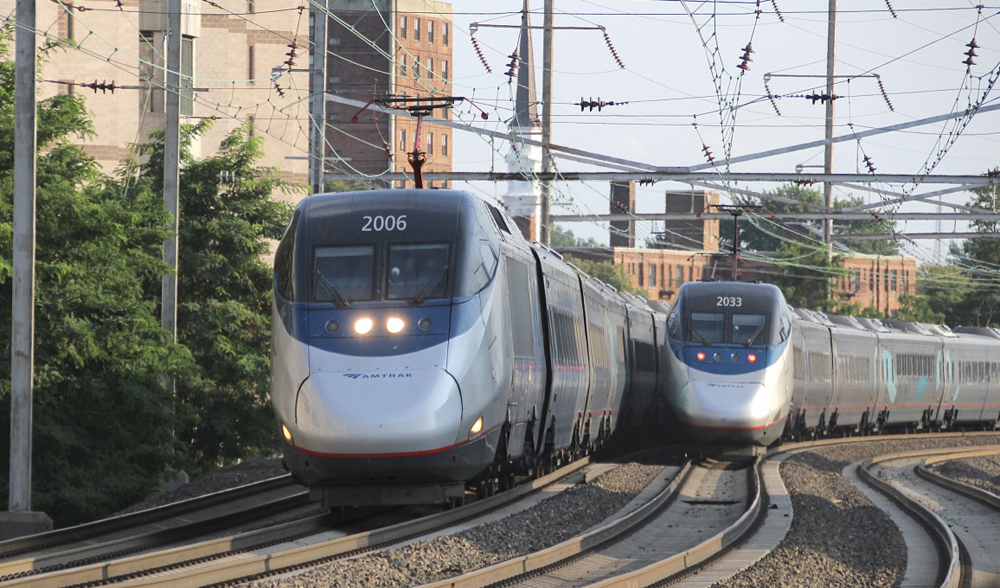
Maximum Acela speeds are 150 mph and the new Acelas will be able to reach 160 mph, but this is currently possible only on about 34 miles of track in Rhode Island and Massachusetts. They will also be able to attain those speeds when almost-completed catenary and track work is done in central New Jersey between Trenton and New Brunswick.
“Amtrak has investigated how to improve [right-of-way] to the maximum extent possible within the land use and regulatory environment it operates in,” Toll says. “However, funding is required to make these improvements. With investment, Amtrak can absolutely increase speeds and reduce trip times.”
So what are realistic goals for travel time? “With funding to replace obsolete infrastructure like the B&P Tunnel and additional targeted investments costing around $50 billion,” Toll predicts, “Amtrak can increase maximum speeds on most of the Northeast Corridor to 160 mph. Acela trip times could be reduced to 2 hours [from a current average of 2 hours, 50 minutes] between Washington and New York City, and 2 hours and 30 minutes from New York City to Boston [now 3:45]. A Washington-to-Boston journey would be 2 hours faster, and riding the Acela from Washington to Baltimore would take just 21 minutes,” she says.
The Northeast Corridor received federal financing for improvements in the 1960s when the Pennsylvania Railroad introduced the Metroliners, as well as periodic funding for better track and higher speeds under Amtrak. But more heavy lifting is needed to squeeze more minutes out of the fastest schedules.
— Updated at 12:30 p.m. on May 11 to correct running speed on Metro-North trackage to 80 mph.